The Solemnity of Pentecost (2026)
What did we just hear?
We heard Jesus make a promise on the night before he died that,
“the Advocate, the Holy Spirit whom the Father will send in my name, will teach you everything and remind you of all that I told you.”
And a few minutes ago, we heard how that promise was fulfilled 50 days after the Resurrection when the Spirit of God came down on that first Pentecost in wind, fire, and voice.
Now, if we take the Readings as they are, it seems to be the end of the story and what we are doing now is simply remembering a past event. But if we pay attention to the prayers and songs of this liturgy, we will realize that today we are still praying for the coming of the Holy Spirit upon the Church and the world.
Because what happened in the Upper Room wasn’t a one-time event. It was, in fact, only a beginning.
We can say this because, even though the Holy Spirit doesn’t always come to us in great signs and wonders as it did for Mary and the Apostles, this same Spirit remains present and active in each of our lives and in the life of the Church. The Spirit continues to move us forward, pushing us beyond the boundaries of the small worlds we make for ourselves and calling us to become more together. Most often, the Spirit does this through the ordinary ways we encounter and shape one another every day.
And, honestly, we already know something about this from our own lives.
Have you ever noticed how one person’s spirit can change an entire room?
One person’s bitterness or anger can spread quickly through a family or community. But so can gentleness. So can patience. So can peace.
Sometimes a single person who listens, who remains calm, who continues to love, and who refuses to give up on others, can hold together a friendship, a family, or a community.
That is part of how the Holy Spirit works.
Not always dramatically.
Not always loudly.
But quietly, steadily, from one heart into another.
…
Centuries ago—sometime before the sixth century—a hermit in the deserts of Egypt wrote this:
“The heart directs and governs all the organs of the body. And when grace pastures the heart, it rules over all the members and the thoughts. For there, in the heart, the mind abides, as well as all of the thoughts of the soul and its hopes. This is how grace penetrates throughout all the parts of the body.”
That nameless hermit (whom we simply know today as Pseudo-Macarius) understood something profound: the human person is most fully alive when the mind and heart move together and are opened to the life of God.
Our minds matter. But we are only at our best when the mind descends into the heart—when our thoughts, desires, hopes, and relationships are shaped by grace.
Today’s celebration reminds us that the Holy Spirit does not simply give individual gifts to isolated people. The Spirit draws people together in bonds of faith and love because human beings were never meant to live in isolation. We are created for communion, and the Spirit makes it possible for us to become something together that none of us could become alone.
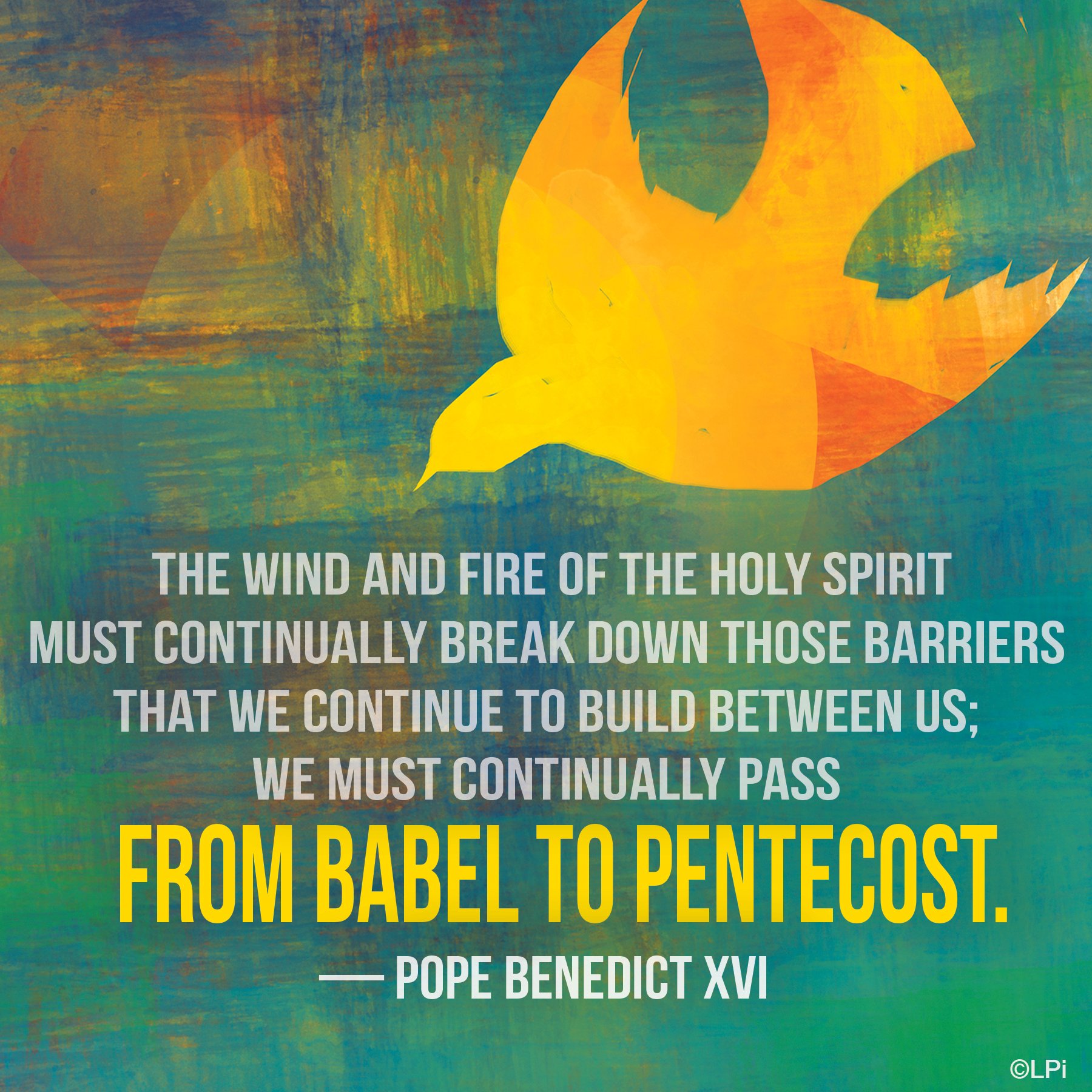
When we think about what happened on that first Pentecost, we see a reversal of the disunity and confusion that began at the Tower of Babel. Rather than a cacophony of voices competing to be heard and speaking over one another, on that first Pentecost each believer spoke a language that those present heard as their own.
And that matters because Pentecost does not erase difference—it allows difference to become communion. The Spirit did not make everyone identical. The Spirit made it possible for people to hear one another again.
And we know how difficult that can be.
We know how easily families stop listening to one another.
How quickly communities become divided.
How easy it is to retreat into suspicion, resentment, or fear.
The Spirit draws together people of different backgrounds, vocations, and gifts into one body without erasing what makes each person unique.
Saint Paul reminds us that, “There are different kinds of spiritual gifts but the same Spirit; there are different forms of service but the same Lord; there are different workings but the same God who produces all of them in everyone.”
And those gifts are not abstract things.
Sometimes the Spirit gives a person the ability to listen deeply to someone who is hurting. Sometimes the gift is the quiet fidelity of a person who continues to love and serve others even when life becomes difficult.
Sometimes the Spirit works through people who simply refuse to give up on one another.
But every gift matters because every person matters.
This Solemnity of Pentecost reminds us that the Spirit is still at work—in the Church, in our communities, in our families, and within our own hearts.
One of the great spiritual challenges of Pentecost is learning to recognize that presence.
To recognize the Spirit at work in the people who continue to choose love instead of bitterness…
forgiveness over resentment…
hope over fear.
Because the Spirit is always leading us beyond ourselves.
Leading us toward one another.
And if the gifts we have received are truly for the common good, then we are called to place them at the service of others—to help heal what is wounded and remind people that they are not alone.
That is how we—the Church—continue to live Pentecost.
And that is how the Spirit continues to renew the face of the earth.
O God, who by the mystery of today’s great feast
sanctify your whole Church in every people and nation,
pour out, we pray, the gifts of the Holy Spirit
across the face of the earth
and, with the divine grace that was at work
when the Gospel was first proclaimed,
fill now once more the hearts of believers.
Through our Lord Jesus Christ, your Son,
who lives and reigns with you in the unity of the Holy Spirit,
God, for ever and ever. Amen.
-Collect for the Solemnity of Pentecost (Mass of the Day)
Homily prepared for Old St. Mary’s Church, Milwaukee, Wisconsin
