Solemnity of the Ascension of the Lord (2026)
The Easter Season is something of a mystery for most Christians. We don’t quite know what to do with it. This is especially true when we compare the Fifty Days of Easter to the Forty Days of Lent.
During Lent, parishes and schools have special programming to help us grow in our disciple-commitment and learn more about our faith; there are special collections for charities and opportunities for Lenten giving; we have additional times for confession and devotions like the Stations of the Cross or Eucharistic adoration.
We have fish fries.
There is a fervor to the Season of Lent that we often don’t find in the days of Easter.
And, when Easter Sunday does come, we sing our Alleluias and proclaim, “He is Risen!”
But—this is where most of us get stuck—as the Easter Season continues, things can become murky. The Day of Resurrection fades into memory, the Easter lilies lose their blossoms, and we are left with seven weeks of sprinkling rites and Paschal Candles, and the question arises: “What are we supposed to be doing for fifty days?”
To answer that, let’s go back to that Easter Sunday proclamation of “He is Risen!”…. The Easter Season invites us to a new perspective by challenging us not simply to proclaim, “He is Risen,” but rather to proclaim, “He is Risen … and…!”
It doesn’t take Fifty Days simply to declare “He is Risen!” We do that well enough on Easter Sunday and during the Octave of Easter. But “He is Risen … and…”—well, that’s a whole other story.
That “and” allows our celebration of Easter to become something open-ended and expansive. It reminds us that the Lord’s Death and Resurrection, Ascension and Glorification are not isolated moments from the past, but an always-unfolding mystery that continues to draw us deeper into discipleship, prayer, and communion with God.
And this helps us understand why the Easter mystery unfolds slowly… because that is often how God works in our lives.
Understanding usually comes gradually.
Meaning often reveals itself over time.
And, as we know, there are moments in life that we do not fully understand when they happen. It is only later—sometimes much later—that we begin to recognize what was really taking place… how something was shaping us, guiding us, or calling us forward.
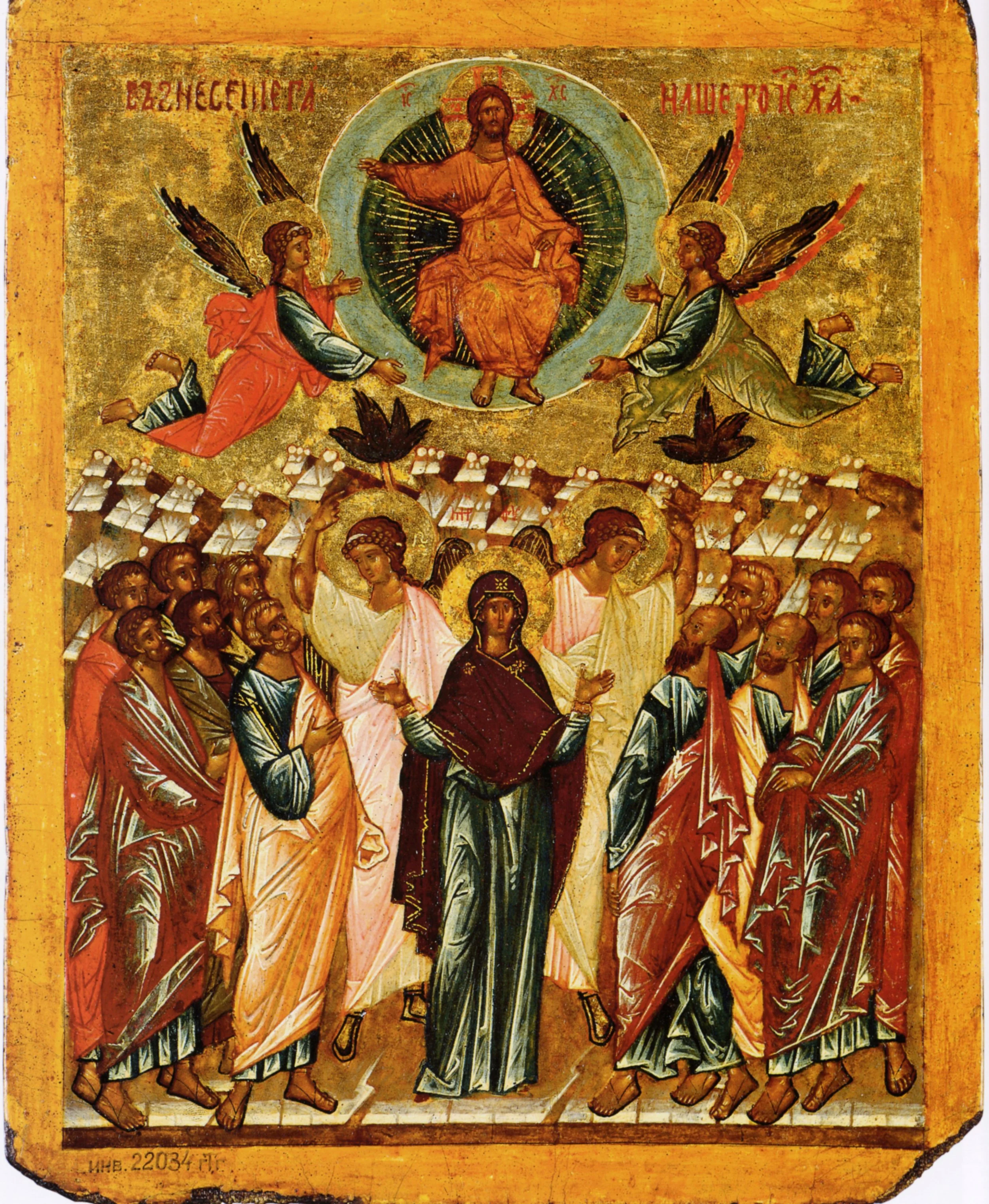
The same was also true of the Apostles and the first generations of Christians: their experience of Jesus’ Ascension was something they could only gradually come to understand, just as the meaning of the Resurrection itself became clearer only through years of praying, preaching, communion, fidelity, and suffering.
And it is precisely into that experience—when Jesus is no longer present to them in the same way—that today’s Gospel speaks. It presents their memory of how the Risen Lord had gathered them together in order to send them out: “Go, therefore, and make disciples of all nations…” And then he gave them this promise: “And behold, I am with you always, until the end of the age.”
The Ascension does not mark the end of Jesus’ presence—it, more importantly, marks the beginning of a new way of being present to them—and to us. No longer bound to one place or one moment, he remains with them—and with us—always.
The spiritual writer Ron Rolheiser, OMI, has observed that “part of the mystery of love is that presence sometimes changes form.” And we know something of this mystery from our own lives. There are people whose importance we only fully recognize over time—sometimes even only after they are gone. A parent, a grandparent, a teacher, a friend, a lover… someone whose love, sacrifice, guidance, or example continues to shape us long after they are no longer present to us in the same way.
What first feels like absence can, over time, become a deeper kind of presence—one carried in memory, in love, and in the ways a life continues to bless and guide others. They remain with us—not as they once were, but still no less truly present.
When we begin to think about the Ascension in this way, we see that this feast is really a celebration of promise:
He promises that his presence does not end—it deepens. What the disciples could not yet fully understand in that moment, they would gradually come to recognize: Christ had not abandoned them. Rather, he was now present to them in a new and more powerful way.
Christ is Risen … and… today’s celebration challenges us to live in that promise.
There are moments when God does not seem immediately present—when we cannot point to a clear answer or direction—and yet, over time, we come to recognize that we were not alone, that something was guiding us, sustaining us, and leading us forward.
What we could not see clearly in the moment becomes clearer in memory.
That is also part of what it means to live Easter faith: to live in such a way that our lives become a blessing for others, carrying forward hope, mercy, faith, and love into the future.
And so the question before us is this: How might Christ already be present and at work in your life, even in ways you do not yet fully see?
Because the meaning of this feast is not simply that Christ has gone to the Father, but that he remains with us—calling us, guiding us, and sending us—so that, in him, our lives, too, might become part of that “and”… that ongoing story of Easter.
Gladden us with holy joys, almighty God,
and make us rejoice with devout thanksgiving,
for the Ascension of Christ your Son
is our exaltation,
and, where the Head has gone before in glory,
the Body is called to follow in hope.
Through our Lord Jesus Christ, your Son,
who lives and reigns with you in the unity of the Holy Spirit,
God, for ever and ever. Amen.
-Collect for the Solemnity of the Ascension of the Lord (Mass of the Day)
Prepared for Three Holy Women Parish, Milwaukee, Wisconsin
