The Memorial of Saint Pancras (2026)
[Note: This homily was prepared for the final all-school Mass of the year for Divine Savior Holy Angels High School, where I serve as chaplain. The First Reading (Acts 16:22-34) tells the story of the arrest and miraculous deliverance of Saints Paul and Silas. During the Mass we also celebrated the liturgical memorial of the martyr Saint Pancras of Rome.]
“You can’t expect me not to talk about Saint Silas in this homily!”
I mean… it’s not every day you get your name in the first reading.
But what is it that we are actually hearing about Paul and Silas today?
They have been beaten.
They have been thrown into prison.
They have been locked in chains.
And, most importantly, they have no control over any of it.
But how do they respond? What are they doing?
They are praying.
They are singing.
Not complaining.
Not shutting down.
Not giving up.
They are praying and singing…
How?
How is that even possible?
Because most of us—if we’re honest—when things don’t go our way, when we feel stuck, when something feels unfair or overwhelming… we don’t usually respond like that.
We get frustrated.
We pull back.
Or we just sit in it and let it weigh us down.
But Paul and Silas show us something different, because even though their situation is limited, their spirit is not.
Even though they can’t control what’s happening to them, they can choose how they respond. And that matters.
Because having faith doesn’t mean that everything will go smoothly.
Faith doesn’t mean that we won’t have moments where we feel stuck—
in a situation,
in a relationship,
in stress or anxiety,
in expectations we don’t know how to carry.
But what faith does mean is that those moments don’t get the final word.
We still have a choice.
We can close in on ourselves…
or we can remain open.
We can let frustration take over…
or we can stay grounded.
We can give up…
or we can keep moving forward—even if it’s just one small step.
And that’s where this connects to the saint we remember today: Pancras of Rome.
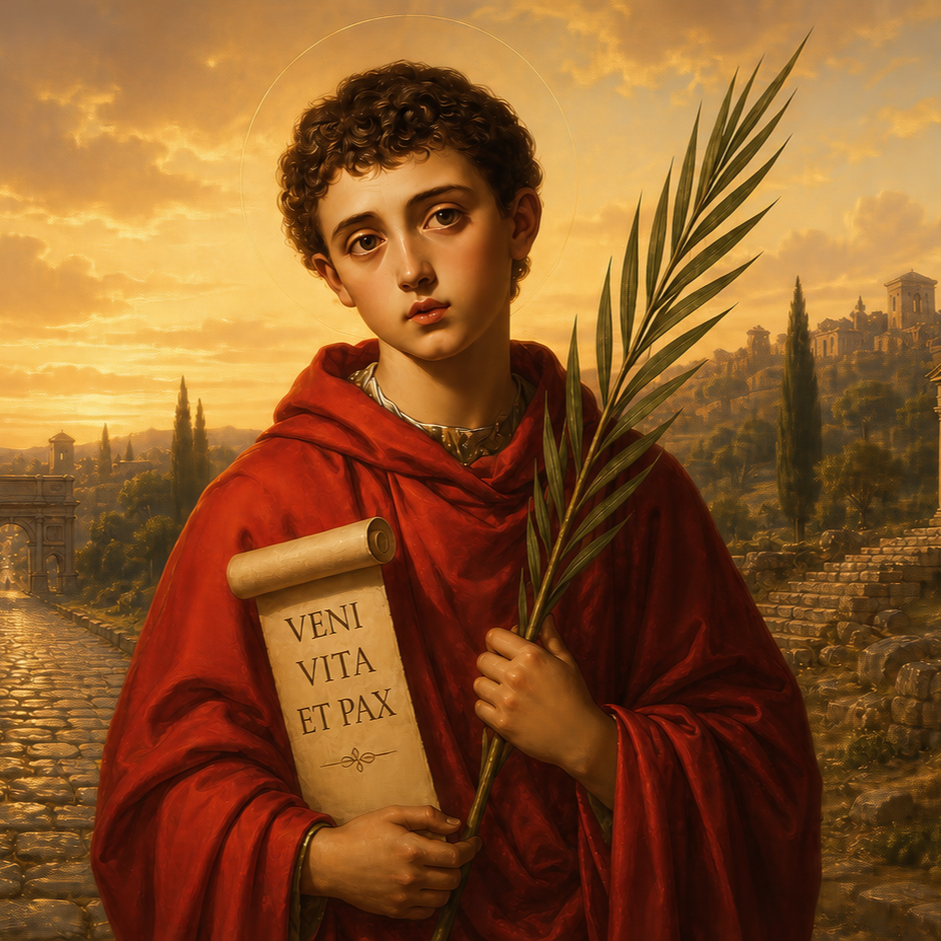
He was young—he was 14 when he was killed because of his faith. And he didn’t get to choose the circumstances of his life either… But he chose how to respond. He chose to remain faithful, even when it was difficult.
And that’s the thread that connects all of this.
Not control… but response.
Not having everything figured out… but staying faithful in the moment.
And maybe that’s the most important thing to hear today:
You don’t have to fix everything.
You don’t have to have your whole life figured out.
You don’t have to solve every problem or carry everything that feels overwhelming.
But you can choose how you respond in this moment.
You can choose to be patient.
You can choose to be honest.
You can choose to show up.
You can choose to pray—even if it feels simple or quiet.
And as we come to the end of this school year—and for our graduating Dashers, your final all-school Mass—this moment matters. You don’t have everything figured out, and you’re not supposed to. But you do get to choose how you move forward from here—how you live, how you respond, how you remain grounded in what is good.
And for all of us who remain—students and TSC—our journey continues—together, learning, growing, and choosing each day how we will live and respond in the moments we are given.
Because the truth is, most of life unfolds in exactly that way—not when everything is clear or easy, but in the middle of uncertainty, in moments that don’t feel finished or resolved. And that is exactly where we find Paul and Silas: They were in exactly that kind of moment—still in prison.
Nothing had changed—at least not yet. But they were not trapped. Because they had a kind of freedom that no one could take away.
And that same freedom is offered to us… We may not control everything that happens in our lives.
But we still have a choice.
