The Third Sunday of Easter (2026)
In October 1979, the South American nation of El Salvador descended into a brutal civil war that led to the systematic oppression and murder of tens of thousands of Salvadorans, particularly poor farmers. Among those who gave their lives in defense of faith and justice were the archbishop of San Salvador Saint Óscar Romero, Blessed Rutilio Grande, a Jesuit Priest, the Franciscan Blessed Cosma Spessotto, and four American women serving as missionaries among the poor: Maryknoll Sisters Maura Clark and Ita Ford, Ursuline Sister Dorothy Kazel, and lay missionary Jean Donovan. A decade later, six Jesuit priests, along with their housekeeper and her daughter, were also murdered because of their commitment to the poor.
The total number of those who were murdered, raped, and tortured during those years is known only to God.
In the year following the death of Archbishop Romero, the Jesuits of El Salvador began a bi-weekly publication known as Letter to the Churches. Through this newsletter, they retold the stories of those who suffered from violence and terror at the hands of both government forces and guerrilla fighters, ensuring that their voices would not be forgotten.
In one issue, “Letter to the Churches” shared the testimony of Ismael, a lay catechist who accompanied groups of displaced families as they fled into the mountains seeking safety. There, hiding beneath the branches of trees, with the stars providing their only light because they were afraid to light candles, the people would retell and reflect on the stories of the Gospel.
Recalling those terrifying days, Ismael wrote:
We suffer a great deal here. Our bodies are wasting away, and we have many worries. The old people and the children we have to carry concern all of us. We have no money, no clothing, no shoes. But God will look after us. We are going to suffer in this life. These are only the birth pangs, but joy will come. The consoling words of Christ will wipe away every tear. No more will there be crying, pain, worry, or death—everything will pass away. Our hope is to know God.
Ismael’s ability to find comfort and hope in Christ is a powerful witness to us in these Easter days, especially as we hear in today’s Gospel the story of two disciples whose own hopes had been shattered.
Saint Luke presents Cleopas and his companion leaving Jerusalem after the death and burial of Jesus. Although they had heard the testimony of the women that Jesus had been raised from the dead, their disappointment and grief would not allow them to believe such an amazing story.
Their despair is captured in one simple but profound statement: “We had hoped…”
And yet, Jesus was there with them, walking beside them through their grief, helping them recognize how God had been—and continued to be—at work in the violence of Good Friday and the silence of Holy Saturday. The Risen Christ reveals that hope is never truly lost and that nothing is impossible with God. As he opens the Scriptures and ultimately makes himself known in the breaking of the bread, the disciples’ hearts begin to burn within them. Their sorrow gives way to joy, their despair to renewed faith, and their first impulse is to return to Jerusalem to announce the Good News.
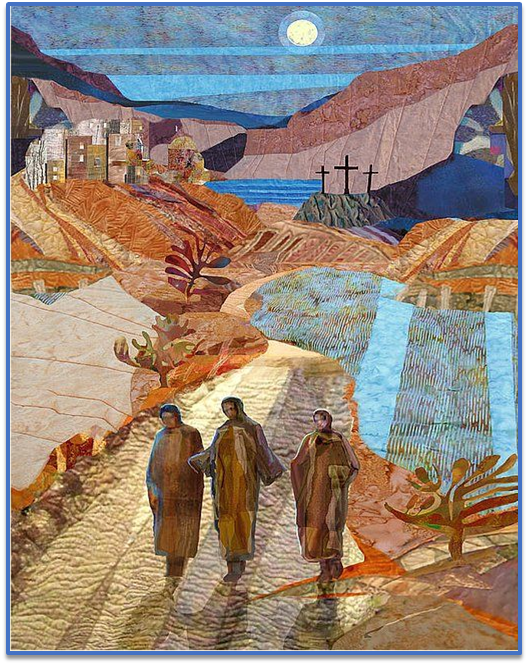
“Emmaus” by Michael Torevell
And what is striking in this Gospel is how ordinary that encounter is. Jesus does not appear to them in glory. He comes to them as a stranger on the road. He listens to them. He walks with them. He opens the Scriptures.
It is only later—only in the breaking of the bread—that they recognize him.
Which means that, even before they knew it, Christ was already with them. Already speaking. Already guiding. Already present in the very moment they believed all hope had been lost.
The hope and promise of the Resurrection on that Easter Day dispelled the darkness of grief and despair for Cleopas and his companion.
And that same hope took root in the lives of people like Ismael and his companions as they hid in the forest during those terrible days in El Salvador.
In both stories, the Risen Christ is not distant from human suffering but is present within it, accompanying his people and transforming despair into hope.
And so the question is not only what happened to them—
but what is happening in us.
Like Cleopas, like Ismael, and like so many witnesses of faith throughout history, we too are invited to recognize the Risen Christ walking beside us—in moments of sorrow and in moments of hope.
In those moments when something in our lives has come to an end—when a relationship changes or is lost, a friendship comes to an end, when a path we had hoped for closes, when something we trusted in gives way to uncertainty.
And also, in those quieter moments of hope—when strength returns, when clarity begins to emerge, when we find ourselves able to take the next step forward… even if we are not entirely sure where it will lead.
This invites us to ask: where might the Risen Christ already be walking beside us today, even if we do not yet recognize him?
This is what we celebrate as we continue to rejoice in this Easter Season: the Resurrection shows us that there is always hope and that Christ remains with us, journeying beside us as we walk our pilgrim path. He meets us along the road of our own lives, often when we least expect it, and reveals himself in the Scriptures, in the Eucharist, and in the quiet assurance that we are never alone. Saint Óscar Romero, who gave his life in witness to this hope, once proclaimed:
Easter is a shout of victory! No one can extinguish that life that Christ resurrected. Not even death and hatred against him and against his Church will be able to overcome it. He is the victor!
May your people exult for ever, O God,
in renewed youthfulness of spirit,
so that, rejoicing now in the restored glory of our adoption,
we may look forward in confident hope
to the rejoicing of the day of resurrection.
Through our Lord Jesus Christ, your Son,
who lives and reigns with you in the unity of the Holy Spirit,
God, for ever and ever. Amen.
-Collect for the Third Sunday of Easter
Homily prepared for Three Holy Women Parish, Milwaukee, Wisconsin
