The Second Sunday of Easter (2026)
In those first days following the death and burial of Jesus, the Apostles were left adrift. After all, the One who had been their focus and point of reference through years of mission and service was gone. God had gone quiet, no longer speaking to them or guiding them.
How could they make sense of everything that had happened to Jesus?
How could they make sense of everything that had happened to them?
There was no escaping the disappointment and disillusionment brought on by the Crucifixion. The darkness of Good Friday had not yet been transformed by the light of Easter.
He stands among them. He speaks peace into their fear.
And everything changed.
The darkness that had overwhelmed them began to lift. Fear gave way to hope. The silence they had experienced was broken by the presence of the Risen Lord.
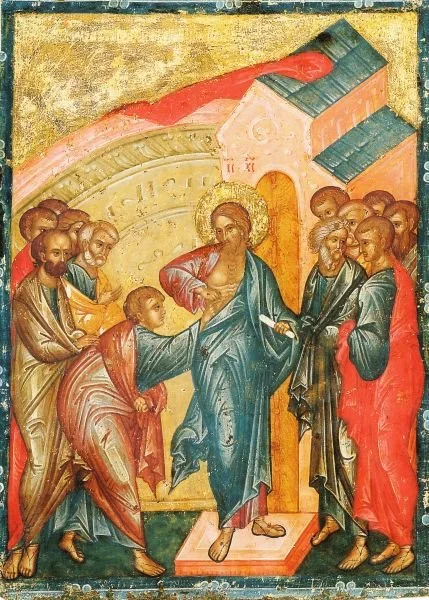
But Thomas had been absent when Jesus first appeared to the Apostles on that first Easter Sunday. Should it be any wonder, then, that he would still be overwhelmed by something like a Holy Saturday sadness? And I don’t think it is fair to fault Thomas for being skeptical of the stories of Mary Magdalene and the others who claimed to have seen Jesus.
This experience is not far from our own. When something completely new enters into our lives—especially something we do not fully understand—we often hesitate. We hold back. We are unsure how to respond. The newness that God brings can be unsettling, even frightening.
Although Thomas did not initially believe in the Resurrection of the Lord, he remained faithful to the call he had received from Jesus—the call to be a part of the community of the Apostles. While his doubts would not allow him to believe that the others had seen the Lord, Thomas never lost faith in their fraternity. And it was ultimately in and through that community that Thomas finally encountered the Risen Christ.
In reflecting on this, Henri Nouwen once noted that Thomas—called Didymus, meaning “twin”—represents something within each of us. We are both believing and doubting. And we need the support and faith of others so that our doubt does not have the final word.
And so, this Gospel invites us to reflect not so much on “Doubting Thomas,” but on the faith of the community of which Thomas was a part—a community where he ultimately encountered the Risen Christ.
And like Thomas, we do not all arrive at that faith in the same way or at the same time. For some, it comes quickly. For others, more slowly—through questions, uncertainty, and the witness of others.
And it is along that journey—often slowly, and sometimes unexpectedly—that we come to encounter the Risen Christ.
We meet him in the Word that is proclaimed.
We meet him in the Sacraments we celebrate.
We meet him in the faith of those who walk beside us.
From that first gathering in the Upper Room to this moment, that same experience continues. Even now, it is in the midst of this community that we encounter the Risen Christ.
While we know that faith is a gift, believing is not automatic or easy. In fact, it is often easier for us to relate to the doubt of Thomas than to the sublime prayer and contemplation of the great saints and mystics. Hate, the threat of war, violence within our communities and homes, discrimination, illness, and enduring hunger—all of these, in ways both large and small, can put our faith to the test.
And yet, Easter reminds us that there is something more powerful than suffering and death: the love of God who, in Christ, has taken upon himself our broken humanity and, in the Resurrection, has overcome it.
This is the mystery we celebrate on this Second Sunday of Easter—the Sunday of Divine Mercy.
And it is into that mystery that today’s Gospel speaks:
“Blessed are those who have not seen and have believed.”
Blessed are we when we accept what has been handed down to us in the faith of the Church.
Blessed are we when we encounter Christ in the Scriptures and the Sacraments.
Blessed are we when we recognize him in the lives of those around us, especially in the poor and the suffering.
Because in all of these ways, Christ continues to stand among us, offering us the same gift he offered to the Apostles:
Peace.
Like Thomas, we are not asked to have all the answers.
We are simply asked to remain—to stay close, to stay within the community, to stay open to the presence of Christ.
And it is here, together, that our doubt is met with mercy…
that our fear is met with peace…
and that our questions are transformed into faith.
