The Fourth Sunday of Easter (2026)
“Faith” and “Hope” are tricky words. Like many other examples from our Christian vocabulary—such as “mercy,” “discipleship,” and “spirituality”—we have a sense of what they mean but most of us would be stumped if we were asked to try to give a concise definition or description of “faith” and “hope.”
One of the reasons that I think this is true is because faith and hope are so essential, so foundational to who we are as human beings—to who we are as believers—that we can take them for granted.
For some of us, however, faith and hope can seem far away. This can be especially true
in times of illness or grief,
when we are navigating life’s inevitable transitions and changes,
when we feel vulnerable, uncertain, or unsafe,
when we’re confronted with senseless acts of hate and violence, and the evils that are taking place in Ukraine, Gaza Strip, Sudan, Haiti, and too many other places in the world.
But there are also simply times in our lives when doubt creeps in and we seem to be left with infinitely more questions than there seem to be answers. In those times, faith might seem like farce and hope like nothing more than naïve optimism.
It can happen in quiet ways—
when a relationship begins to change or fade,
when a path we had hoped for closes,
when we find ourselves carrying responsibilities or burdens we never expected.
In those moments, faith can feel uncertain, and hope can feel distant—not because they are gone, but because we struggle to recognize them.
And perhaps that is because faith and hope are not abstract ideas to be defined, but realities we learn by listening—by learning to recognize the voice of the One who calls us forward.
It is precisely in those moments that today’s Gospel speaks most clearly to us.
On this Fourth Sunday of Easter—this “Good Shepherd Sunday”—faith and hope come together in a particular way, as the Readings invite us to find comfort and assurance in the One who is, as the First Letter of Peter reminded us, the “shepherd and guardian” of our souls.
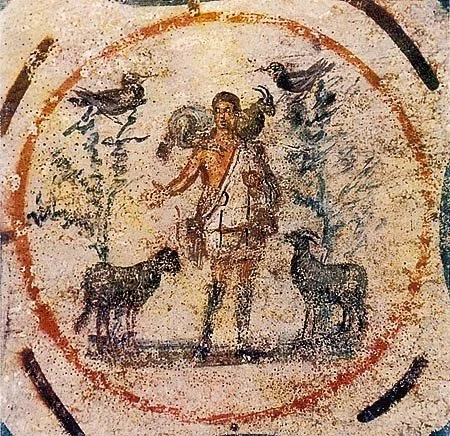
Now, the Evangelist John uses the image of this Good Shepherd to illustrate the intimate way Christ knows each of us and how, like a vigilant shepherd, he constantly watches over us and lifts us up.
The Good Shepherd knows his sheep, and he protects and provides for his flock.
As we continue our journey through this Easter Season, I think it’s fair to say that the celebration—the joy—of Easter Sunday has begun to fade into memory. But today, we’re not only being invited to consider how the Risen Christ remains with us, but we’re being reminded of the ways that he cares for us. The Readings and the entire liturgy today are calling us to faith by reminding us of the “goodness and kindness” of our Shepherd. And because we remember what God has done—what God is doing—we can say “I believe.” This is the starting point of faith.
This faith empowers us to open our eyes to see, to recognize, the gifts, the abundance of life that are offered to us.
But this gift of “abundant life” also asks something of us, because we have to be willing to listen to and follow the voice of our Shepherd.
And this is how faith begins to take shape—not in theory, but in response to that voice.
And this listening—this response to the Shepherd’s voice—is not just an idea—we see it lived out in the preaching and witness of Peter and those first Christians in this Sunday’s First Reading:
Their faith,
their obedience—
that willingness to follow the Shepherd—
transformed them, and they proclaimed, without fear, that God calls all of us to do and be more in Christ Jesus. And as we heard, the Holy Spirit blessed the Church (through their faith and witness) with many new members.
We can, we should take comfort in the Shepherd’s provident care and protection… and the gift of abundant life that he offers us. But we can only say we truly know this Good Shepherd if we are willing to listen to his voice and follow his commands in our daily lives. To belong to him is not simply to be known by him, but to be among those who hear his voice and respond.
If faith and hope depend on hearing that voice, then the question becomes…
But how do we recognize that voice?
First, the voice of the Shepherd—God’s voice—never forces us. God proposes himself… he does not impose himself. As Pope Francis reminded us more than once: God invites, but he never compels—he respects our freedom. This means that God’s voice is not found in pressure or fear, but in the quiet invitation that calls us forward, even when we are unsure.
And when we begin to recognize that voice, we discover something else as well:
The voice of the Shepherd encourages us and consoles us. It nourishes hope.
And so, faith and hope come together in the voice of our Good Shepherd.
God’s voice is a voice that has a horizon. It’s not like the cacophony of voices that surround us—the voices that can often overwhelm us—
by limiting our vision,
by keeping us stuck in the past, nursing hurts and grudges,
voices of judgment that only speak to us of what is wrong and lacking in the world, in others, and even in ourselves,
voices that tell us to only pay attention to what is easy, expedient, or immediate.
These are voices that turn us inward, that make our world smaller—narrowing our vision, closing us in on ourselves, and leaving us focused only on what is immediate, manageable, or within our control.
Instead, the voice of our Good Shepherd invites us to faith in this present moment:
“Now you can do good,” he says,
now you can exercise the creativity of love.
Now you can be free.”
Because the voice of the Shepherd is expansive—it draws us out of ourselves. It opens up a horizon before us… and within us. It invites us beyond fear, beyond self-protection, beyond what is comfortable, and leads us into a life that is wider, deeper, and, ultimately, free...
And to be free means that we follow… we follow our Shepherd, moving beyond the immediate and the comfortable, into a future that is full of hope. As Psalm 23 reminded us:
Only goodness and kindness follow us
all the days of our life;
and we shall dwell in the house of the LORD
for years to come.
We hear that voice in small but real ways—
in a moment of clarity,
in the encouragement of another person,
in the quiet conviction to choose what is good, even when it is difficult.
Because this is where faith and hope are found—not in having all the answers, but in learning to recognize and trust that voice.
Maybe you already that voice speaking to your heart…
And so, the invitation placed before us today is simple:
to listen—to listen for the voice of the Shepherd in our lives…
and to trust that his voice is leading us not into fear,
but into freedom…
not into what is easy or immediate,
but into a future filled with hope.
Almighty ever-living God,
lead us to a share in the joys of heaven,
so that the humble flock may reach
where the brave Shepherd has gone before.
Who lives and reigns with you in the unity of the Holy Spirit,
God, for ever and ever. Amen.
-Collect for the Fourth Sunday of Easter
Prepared for Old St. Mary’s Church and Divine Savior Holy Angels High School, Milwaukee, Wisconsin
