The Twentieth Sunday in Ordinary Time (2026)
This Sunday’s Gospel is one of the most difficult passages in all of the New Testament.
It makes us uncomfortable because, at first glance, Jesus seems unlike the Jesus we have come to know.
A desperate mother approaches him, begging him to heal her daughter. But Jesus says nothing.
The disciples don’t know what to do with her, so they want to send her away.
Then, when Jesus finally speaks… he compares her to a dog. It’s hard and we can’t explain it away. But we can still gain some insight into what’s going on if we think about where Jesus is.
In this story, for the first time in Matthew's Gospel, Jesus has traveled into the Gentile region of Tyre and Sidon. He is no longer in Jewish territory. The woman who approaches him is introduced very deliberately as a Canaanite. Matthew is reaching back into Israel’s history and recalling the memory of Israel’s oldest enemies.
Everything about this encounter suggests distance.
She is a woman.
She is a Gentile.
She is an outsider.
And that’s why the disciples want her sent away. The boundaries could hardly be drawn more clearly.
Her first words, however, are deeply familiar to us: Kyrie eleison—"Lord, have mercy."
Those are the very words we ourselves pray at the beginning of every Mass. This mother doesn’t begin with an argument. She begins with a cry for mercy. And that makes the “dog” comparison all the more difficult to hear.
Now, Scripture scholars have pointed out that the word Jesus uses refers to household dogs rather than wild dogs. That may soften the image slightly. But the fact remains… this is still an insult.
The woman, however, refuses to leave.
She isn’t intimidated.
She isn’t offended into silence.
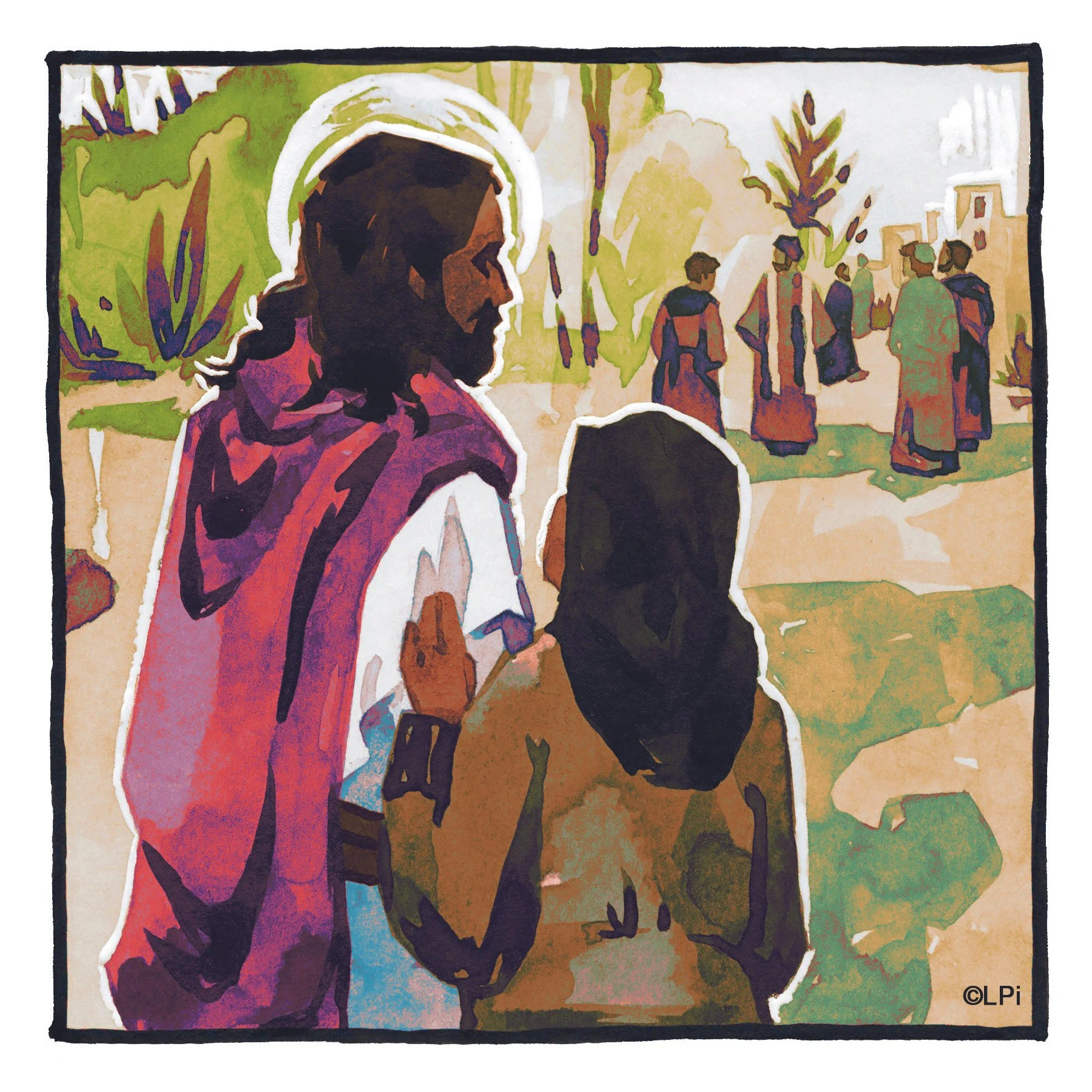
Instead, she answers Jesus with remarkable courage and even remarkable wit: “Yes, Lord. But even the dogs eat the scraps that fall from their masters' table.” This isn’t a desperate response. No. It is the response of a mother who refuses to give up on her child.
This woman refuses to believe that the mercy of Jesus could ever be too small for her daughter. And so, she takes Jesus' own image and turns it into an act of extraordinary faith: “If there are scraps at your table, Lord, then surely even they are enough.”
She’s right. And there is Jesus’ response: “O woman, great is your faith!”
Only twice in Matthew's Gospel does Jesus praise someone's faith in this way. And, both times it is a Gentile.
That detail should make us stop and listen. Because there is another question quietly unfolding beneath the surface of this story.
What does this woman see in Jesus that even the disciples have not yet fully seen?
She sees something the disciples have not yet grasped —She trusts that the mercy of Christ is greater than every boundary standing between them.
The disciples see reasons why she should be sent away. She sees only a Lord whose mercy cannot be exhausted.
The disciples see limits. She sees abundance.
The disciples see an outsider. She sees a Savior.
All of this should change the way we hear this Gospel. And the remarkable thing about this story is not simply that her daughter is healed. It is that the woman knows the mercy of Christ more completely than those who have been walking beside him.
That realization should also change the way we understand ourselves. Every one of us lives by mercy.
Before anything else is true about us—before our accomplishments, before our failures, before the many ways we identify ourselves—we are people who have first been met by the mercy of God.
That is true from the very beginning of our lives. It is what Baptism proclaims. Long before we could choose God, God had already chosen us. Long before we could speak his name, God had already called us his own.
The Canaanite woman reminds us what it means to live by mercy. She does not approach Jesus claiming a right or a privilege. She entrusts herself entirely to his compassion. In the end, that is the posture of every disciple—not people who have earned God's favor, but people who continue to live by his mercy every day.
That is why this Gospel has such profound consequences for the Church. Every generation is tempted to draw new boundaries around the mercy we ourselves have received. Sometimes we do it consciously. Sometimes without ever realizing it.
We quietly decide who belongs.
Who does not.
Who is welcome.
Who is beyond hope.
But this Sunday’s Gospel gently asks us a different question: If the mercy of Christ proved greater than every boundary standing before this woman, what boundary could possibly keep someone beyond the reach of that same mercy today?
This is why I have always loved the way Romano Guardini reflected on this mystery, when he wrote, “What comes from God does not discriminate, qualify or limit; it overflows freely from his bounty.” That is exactly what today's Gospel reveals: the mercy of God overflows every boundary we construct.
It overflows ethnicity.
It overflows history.
It overflows prejudice.
It overflows every "us" and every "them."
Because the woman who cried, "Lord, have mercy," discovered something the disciples were only beginning to understand: The mercy of Christ is always greater than the boundaries we imagine.
O God, who have prepared for those who love you
good things which no eye can see,
fill our hearts, we pray, with the warmth of your love,
so that, loving you in all things and above all things,
we may attain your promises,
which surpass every human desire.
Through our Lord Jesus Christ, your Son,
who lives and reigns with you in the unity of the Holy Spirit,
God, for ever and ever. Amen.
-Collect for the Twentieth Sunday in Ordinary Time
Homily prepared for Divine Savior Catholic Church in Orangevale, California
