The Nineteenth Sunday in Ordinary Time (2026)
Four years ago, I had the opportunity to make a pilgrimage to the Holy Land with a group of Carmelites. One of the places we visited was Mount Carmel, where tradition tells us the Prophet Elijah carried important part of his ministry, including a cave where he lived during that time in his life.
Although the cave isn’t large, it is surprisingly deep and remarkably quiet. Standing there in the silence, it wasn't difficult to imagine Elijah in conversation with God in that still, quiet space. I was fortunate to spend a few moments there by myself.
As I walked back toward the mouth of the cave, everything changed. Before me I saw the expanse of the Mediterranean Sea. A gentle breeze was blowing in from the water, and for just a moment it was easy to imagine God's whisper being carried on that ocean breeze.
Ever since that pilgrimage, I have thought of that quiet cave on Mount Carmel whenever I hear Elijah’s story.
Now, the cave we hear about in the First Reading was on Mount Horeb, not Mount Carmel. But standing in that sacred, silent space on Mount Carmel helped me imagine what Elijah may have experienced when, during one of the darkest moments of his life, he met the Lord in the silence.
As he stood at the entrance of that other cave,
The wind tears across the mountain.
An earthquake shakes the ground.
Fire passes before him.
Each speaks of God's power. Yet the Lord chooses to reveal himself in what is described as "a tiny whispering sound." This wasn’t because God was absent from the wind or the earthquake or the fire. Rather, this moment of revelation reminds us that God most often reveals his presence, not in overwhelming displays of power, but in quiet and unexpected ways.
The Gospel speaks of that same mystery.
Remember what we heard—the disciples have spent the night battling wind and waves on the Sea of Galilee. They are exhausted. The storm has become the only reality they can see. When they notice Jesus approaching across the water, fear narrows their vision, and they struggle to make sense of what they are experiencing. In the darkness they strain to find an explanation—even one as unlikely as a ghost!
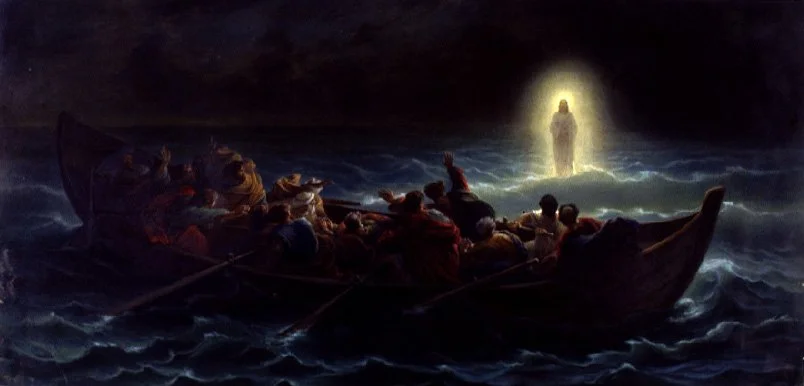
“Christ Walking By the Sea” by Amédée Varint
Then Jesus speaks: “Take courage. It is I. Do not be afraid.”
In those words, Matthew reveals who Jesus is: He is “I am.”
The One standing before the disciples claims the very name God revealed to Moses at the burning bush. Before the storm is calmed, before Peter takes a single step, Jesus reveals that the deepest reality confronting the disciples is not the wind or the sea. It is the presence of God.
Peter responds with that wholeheartedness that so often characterizes him. At Jesus' invitation, he climbs over the side of the boat, and for a brief and extraordinary moment he does the impossible.
But the storm has not disappeared.
The wind is still blowing.
The waves are still crashing around him.
And suddenly Peter realizes how small he is before the immensity of the storm.
That is deeply human.
There are moments when life makes all of us feel small. Not insignificant, but aware that we are standing before realities much larger than ourselves. A diagnosis changes everything. Someone we love dies. A marriage begins to unravel. We can carry a quiet loneliness, even in a crowded room. We wonder whether we truly belong. The future becomes uncertain, and we discover that there are some storms we cannot control, no matter how hard we try.
In moments like those, our experience of faith can seem to ebb and flow. There are days when trust comes almost effortlessly, and there are days when it seems to slip through our fingers.
The thirteenth-century Sufi poet Rumi once wrote that we live with "a deep secret that sometimes we know, then not, and then know again."
Most of us recognize that movement within ourselves. Because we know that there are seasons when God's presence seems unmistakable. There are seasons when it seems hidden behind the winds and waves of life.
But this Sunday’s readings reveal an even deeper truth—God's faithful presence does not rise and fall with our awareness of it.
And so, as Peter begins to sink, he cries out, “Lord, save me!” Matthew tells us that Jesus immediately stretches out his hand and catches him. It’s only after Peter has been lifted from the water does Jesus ask, “O you of little faith, why did you doubt?”
That sequence matters.
Jesus didn’t wait for Peter to become stronger.
He didn’t ask Peter to prove himself before extending his hand.
Grace comes before correction. The outstretched hand precedes the question.
Even more striking, Jesus reaches for Peter before he stills the storm.
Peter is rescued while the wind is still blowing.
The sea is calmed only afterward.
Matthew is revealing something profound. God's saving presence does not always remove the storm immediately. Sometimes it is experienced in the midst of the storm—one outstretched hand at a time.
That same truth quietly echoes through Elijah's story. The mountain remains the mountain. The dangers surrounding him have not disappeared. Yet, in the silence, Elijah discovers that God has never abandoned him.
That is the God revealed to us in today's readings.
Not a God who promises that every storm will quickly pass.
Not a God who asks us never to struggle or never to feel small.
But the God whose faithful presence remains unchanged, even when everything around us seems uncertain. That is why the Psalmist can pray with such quiet confidence: “I will hear what God proclaims; the Lord—for he proclaims peace.”
Not because every question has been answered.
Not because every fear has disappeared.
But because God never ceases to be present.
The whisper is quieter than the wind. But it is also stronger than the storm.
Almighty ever-living God,
whom, taught by the Holy Spirit,
we dare to call our Father,
bring, we pray, to perfection in our hearts
the spirit of adoption as your sons and daughters,
that we may merit to enter into the inheritance
which you have promised.
Through our Lord Jesus Christ, your Son,
who lives and reigns with you in the unity of the Holy Spirit,
God, for ever and ever. Amen.
-Collect for the 20th Sunday in Ordinary Time
Homily prepared for St. Pius X Parish in Wauwatosa, Wisconsin
