The Eighteenth Sunday in Ordinary Time (2026)
The most important things in life can never be earned. They can only be received.
The love of our families.
The gift of forgiveness.
Friendship.
God’s grace.
Even life itself.
These are gifts that no amount of money or effort could ever purchase, and that is the thread running through all three readings this Sunday.
God does not begin by asking what we have accomplished. God begins by inviting us to receive. Only then does he ask us to respond.
The prophet Isaiah captures this truth when he offers one of the most remarkable invitations in all of Scripture: “Come to the water, all you who are thirsty... Come, receive grain and eat; come, without paying and without cost.”
It is almost scandalous.
Isaiah reminds us that God's relationship with us has never been a transaction. Love, mercy, forgiveness, grace, and salvation are not wages for good behavior. They flow from the generosity of God and can only be received as gifts.
Saint Paul builds on that same truth in the second reading. He doesn't encourage us to become stronger or more self-reliant. Instead, he reminds us that nothing—not hardship, distress, persecution, famine, nakedness, peril, sword, or even death itself—can separate us from the love of God in Christ Jesus.
Notice where Paul tells us to place our confidence: it’s not in ourselves and it’s not in our accomplishments. Our confidence rests in the God who has already claimed us as his own.
Then we come to the Gospel.
In this story, the disciples recognize a very real problem. Thousands of people have been listening to Jesus all day. Evening is approaching, and everyone is hungry. Their solution seems perfectly reasonable: “Dismiss the crowds so that they can go to the villages and buy food for themselves.”
On the surface, there is nothing unreasonable about that suggestion. In fact, it reflects the way many of us instinctively think. People are responsible for meeting their own needs. If they are hungry, they should buy food. If they have a problem, they should solve it.
Jesus refuses that solution: “There is no need for them to go away. Give them some food yourselves.”
The disciples immediately protest. They have only five loaves and two fish. It’s hardly enough for twelve people, much less several thousand. That is precisely the point.
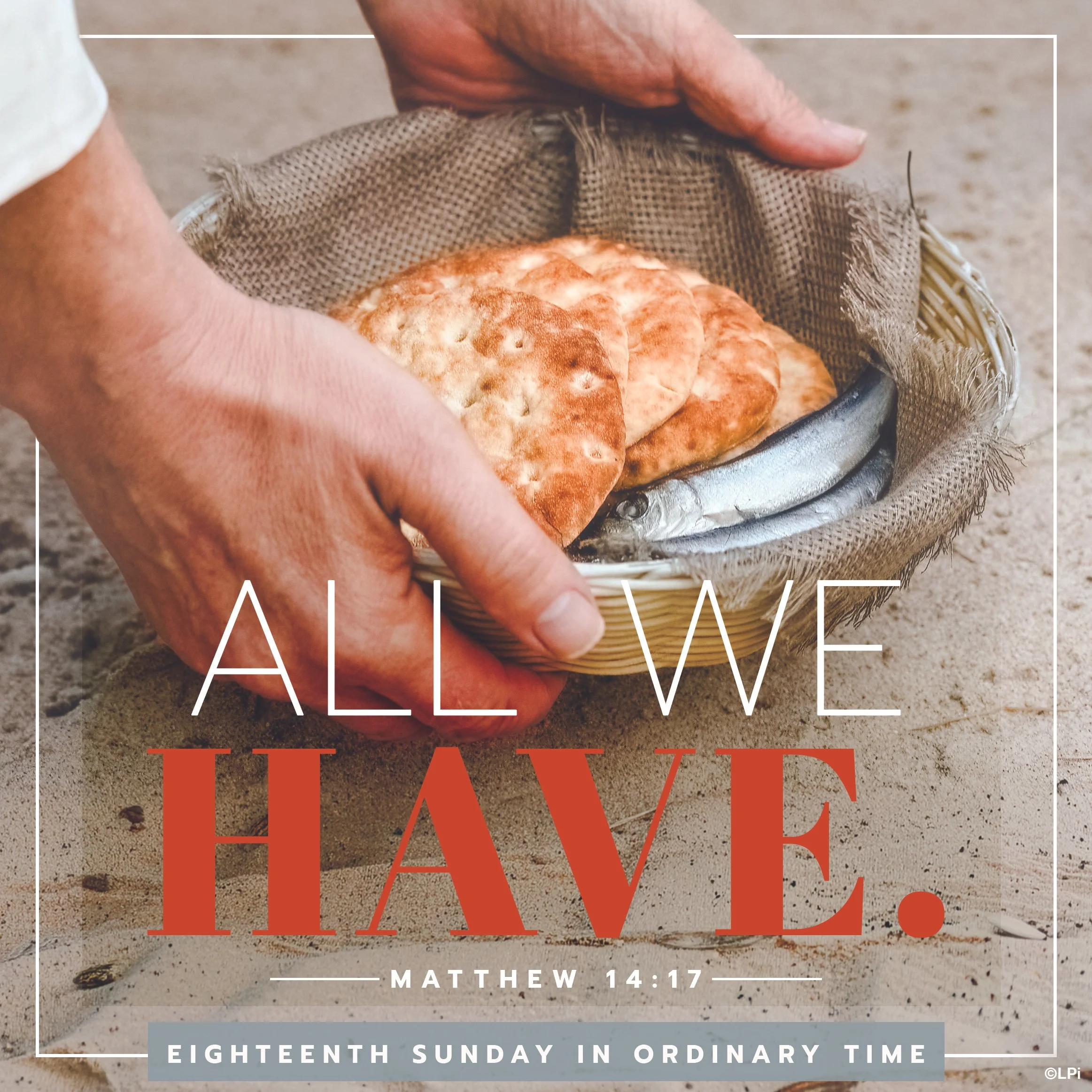
Jesus never expected the disciples to solve the problem by themselves. He simply asks them to place into his hands the little they had. And then Saint Matthew describes Jesus' actions in words that should sound familiar to every Catholic.
He took the bread.
He blessed it.
He broke it.
He gave it to the disciples.
Those are not accidental details. Long before he tells the story of the Last Supper, Matthew is already teaching us something about the Eucharist.
The miracle isn't simply that the bread is multiplied. The miracle is that God's abundance begins where our resources and our calculations falter.
And notice something else. Jesus could have fed the crowd without the disciples. Instead, he chose to begin with the five loaves and two fish they placed into his hands. God's grace does not eliminate our participation; it transforms it.
I appreciate the observation of Sister Barbara Reid, who notes that the disciples' first instinct was to send everyone away to fend for themselves. Jesus redirects them toward something entirely different—not self-sufficiency, but communion. Not isolation, but a community gathered around him, trusting that God will provide what no one person could provide alone.
That’s where this story becomes a challenge for us.
There are moments when we all believe we have to carry everything ourselves: our burdens, our fears, our grief, oufuture. We assume that if we cannot solve our problems on our own, no one else can. The Gospel gently exposes that illusion, because the Christian life has never been about pretending we have enough. It has always been about placing what little we have into the hands of Christ. And we do this every Sunday when we come to this altar carrying our own "five loaves and two fish."
Sometimes it is a tired faith.
Sometimes it is a wounded heart.
Sometimes it is the quiet ache of wondering whether we truly belong.
Sometimes it is a struggling family or a quiet hope we scarcely know how to express.
It never feels like enough.
Yet every celebration of the Eucharist reminds us that God never asks us to begin with abundance. He simply asks us to place what we have into the hands of his Son.
And Christ takes it.
He blesses it.
He breaks it.
And he transforms our small offering by giving us himself as the Bread of Life.
Every Eucharist is Isaiah's invitation fulfilled. We come hungry. We come thirsty. And we’re welcomed not because we have earned a place at the table, but because Christ has invited us. And all this reminds us that the God revealed in these readings is not a God of scarcity. No. The God revealed to us this Sunday is the God of extravagant generosity—the God who always gives before asking, whose grace is greater than our weakness, and whose love can never be exhausted.
That is why our hope can never rest in our ability to provide for ourselves. Our hope rests in the God who has already given us everything in his Son.
Draw near to your servants, O Lord,
and answer their prayers with unceasing kindness,
that, for those who glory in you as their Creator and guide,
you may restore what you have created
and keep safe what you have restored.
Through our Lord Jesus Christ, your Son,
who lives and reigns with you in the unity of the Holy Spirit,
God, for ever and ever. Amen.
-Collect for the 18th Sunday in Ordinary Time
Homily prepared for St. Pius X Parish in Wauwatosa, Wisconsin
