The Solemnity of Saint Pius X, Pope
With the permission of the archbishop of Milwaukee, our parish has transferred the liturgical celebration of Saint Pius X, our parish patron, from August 21 to the Sunday Masses on August 22 and 23.
Several years ago, I read the novel The Snow Queen by Michael Cunningham. It’s the story of two brothers coping with the death of their mother and their family’s histrionics. One of the brothers, Barrett, is always trying to find a way to escape his own life and, over the course of the novel, he comes to realize how shallow he has become. At one point in the story, he remarks that, “The moment matters more than the future. The present—today, tonight; the sensation of walking into a room, and creating a real if fleeting hush—is what I care about, it’s all right with me if I leave nothing behind.”
Barrett isn’t worried about future generations or what contributions he can make to bring light or joy or peace or anything else into the world. As he says, “It’s all right if I leave nothing behind.”
If we think about what’s going on beneath the surface here, we realize that the focus is really on me and what is best for my life. These values can give us permission to ignore what is going on around us, as long as I am not affected, and effectively prevent any outside voice from disrupting or forming the life that I have chosen for myself.
This tendency to live only for the self and for “now”—this moment—reveals how hard it can be to live for the future. But the Gospel is asking us to embrace a totally different mindset and view of the world. As Christians, we are called to live not only for the present moment, but for what comes after us.
We are being asked to be very aware of what it is we leave behind. That is what makes today's Gospel such a powerful reading for the feast of our parish patron: Pope Saint Pius X.
Jesus asks Peter a very simple question: “Do you love me?”
Peter answers three times, “Yes, Lord, you know that I love you.”
And each time, Jesus gives him a responsibility: “Feed my lambs.” “Tend my sheep.” “Feed my sheep.”
Peter's love for Christ is not meant to remain something private between Peter and Jesus. His love becomes a mission. Because he loves Christ, he is entrusted with caring for those whom Christ loves.
Peter could not have known what that responsibility would eventually mean. He could not have imagined the Church that would grow from that small community gathered around Jesus. But he received something, and then he handed it on.
That is an important part of what it means to be a Christian. Every one of us is here because someone came before us. Someone taught us to pray. Someone brought us to Mass. Someone showed us what it meant to forgive, to serve, to remain faithful, or simply to keep going when faith was difficult. We have inherited something we did not create.
And now it is our turn.
Saint Pius X understood this deeply.
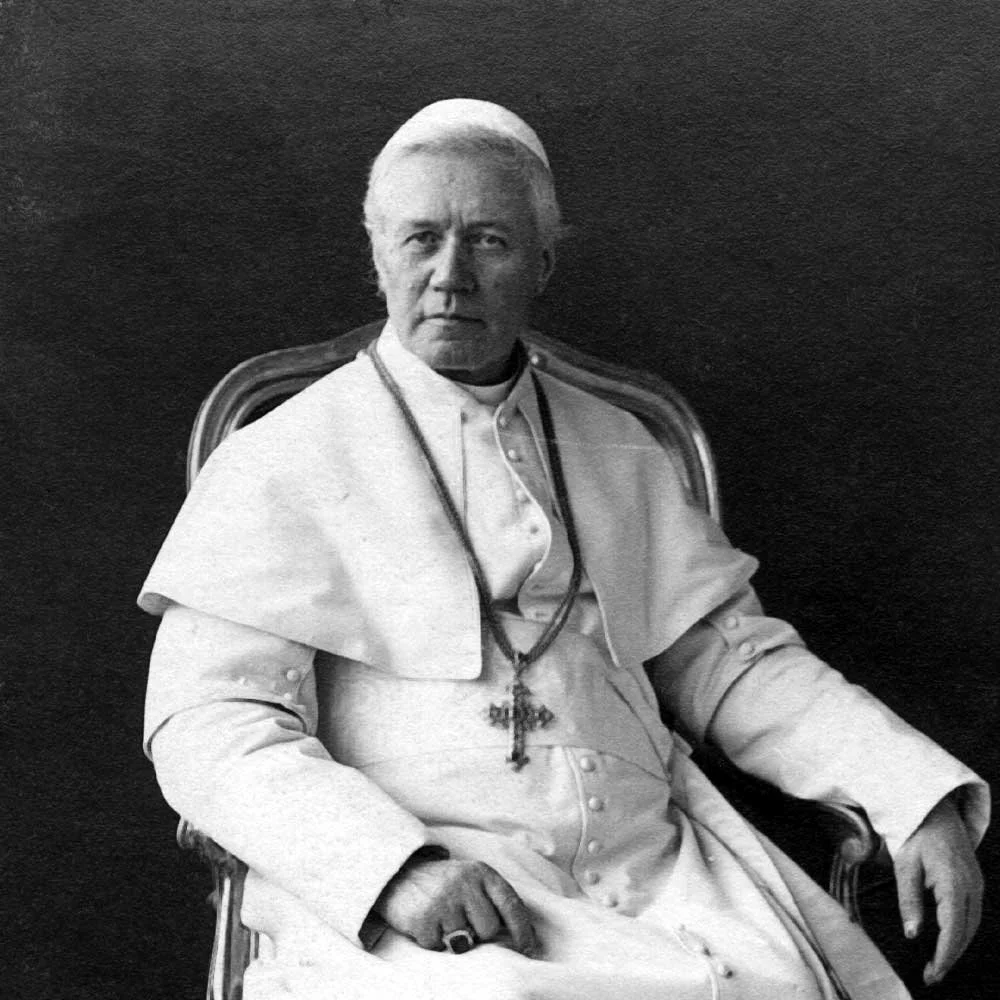
Giuseppe Sarto was born into a poor family in northern Italy, became a parish priest, then a bishop, and eventually served as Pope from 1903 until his death in 1914. He inherited a Church with centuries of tradition, prayer, theology, and sacramental life behind it. But he did not believe that receiving that inheritance meant simply preserving everything exactly as he had found it.
His motto was Instaurare omnia in Christo: “To restore all things in Christ.” For Pope Pius X, restoration did not mean simply returning to the past. It meant bringing Christ more fully into the life of the Church and the world. He called the whole Church to participate in that work.
One of the clearest examples was his concern for the Eucharist.
Pope Pius X encouraged Catholics to receive Holy Communion more frequently, including daily Communion, and in 1910 he established that children who had reached the age of reason could receive their First Communion. In doing this, Pope Pius X was living out the command Jesus gives Peter: “Feed my sheep.”
He understood that the Eucharist is not simply something we receive on special occasions. It is the food Christ gives to sustain his people in the life of faith. Pope Pius X wanted the Eucharist to become more deeply woven into the ordinary life of Catholics.
But Pope Pius X did more than preserve what he had received. He discerned what the Church needed in his own time and sought to meet those needs by returning again and again to Christ.
That is what To restore all things in Christ really means.
Sometimes faithfulness means building something new. It can mean preserving something precious. At other times it means correcting what previous generations got wrong. Sometimes it means simply making sure that the faith survives in a form that another generation can receive.
All of that requires discernment.
We have to ask what we have received, what remains essential, what needs to change, and what those who come after us will need in order to encounter Christ.
In that sense, we are called to do more and be more—not because we need to make the Church bigger or better than the generations before us, but because we have inherited their gifts and are now responsible for allowing those gifts to meet the needs of our own time.
That is what it means to become good ancestors.
A good ancestor understands that life is not simply about what we accomplish for ourselves today.
A good ancestor recognizes that our choices become part of the world someone else will inherit.
Saint Peter was asked to feed Christ's sheep.
Pius X put that conviction into practice.
And we have been entrusted with the same responsibility in our own time.
We have received much.
We have been entrusted with much.
And the question before us is not whether we love Christ. Peter answered that question for us.
The question is what our love for Christ will lead us to do for those who come after us. Because Christian discipleship is never only about the life we are living now. It is also about the faith, the hope, and the love we place into the hands of a future we will never see.
O God, who to safeguard the Catholic faith
and to restore all things in Christ,
filled Pope Saint Pius the Tenth
with heavenly wisdom and apostolic fortitude,
graciously grant
that, following his teaching and example,
we may gain an eternal prize.
Through our Lord Jesus Christ, your Son,
who lives and reigns with you in the unity of the Holy Spirit,
God, for ever and ever. Amen.
-Collect for the Memorial of Saint Pius X
Homily prepared for St. Pius X Parish in Wauwatosa, Wisconsin
