Saints Peter and Paul (2026)
At the heart of the Gospel proclaimed on this feast is this question: “Who do you say that I am?”
What’s your answer?
Maybe you might respond like the “some” referenced by the Apostles—Jesus is a nice guy, a good moral teacher, someone who tells us all to get along and be kind to each other.
On the other hand, maybe your answer might be something formulaic… what you learned from the catechism your learned as you were growing up: Jesus is the Word Incarnate, the Second Person of the Trinity, two Natures in one Person, and so on.
Peter and Paul—the Apostles whom we honor today—spent their lives coming to an ever deeper understanding of who Jesus was and they dedicated all their energy to sharing with others what they had come to know to be true.
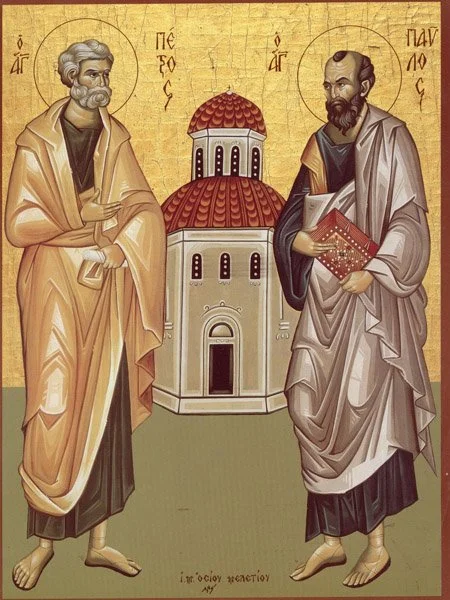
As we think about their faith and celebrate their legacy today, we realize that each of them offers us a model of faith…
First, there is Saint Peter.
In him, we find a man whose faith journey was marked by high highs and the lowest of lows, including his outright denial of even knowing Jesus only hours after that Last Supper on the night before Jesus died. Peter's story reminds us that discipleship is often a gradual process of growth, failure, mercy, and beginning again.
His spiritual journey is very similar, I would imagine, to the spiritual journey of many of us in this Church. We have heard the Lord's invitation to “come and see,” and we may have even left behind things that represented the past—possessions, habits, relationships, or preferences—in order to make the Gospel real in our daily lives. But growing in faith is a process of unfolding, of going deeper into the mystery of who Jesus is, even as we continue to wrestle with those parts of ourselves that remain in need of healing and forgiveness.
Saint Peter reminds us that, although we might fail in our commitment to live as disciples, the Lord continues to invite us, offering us the opportunity to begin again. The call to do and to be more is always there, as is the gift of grace that allows us to accept and live into that invitation.
Paul's story is quite different.
Unlike Peter, Saint Paul’s coming to Christ happened all at once. Graced with an encounter with the Risen and Ascended Lord as he made his way to Damascus changed the trajectory of his life. The persecutor became a disciple, and the disciple became an Apostle.
Paul spent the rest of his life proclaiming to anyone who would listen who and what he knew Jesus to be.
But as we think of Paul's encounter with Christ—that encounter that changed everything—we also have to remember why he was there in the first place. There was nothing about Saul that would have fit anyone's idea of a future disciple. Yet he became the one chosen to carry the Gospel to the nations.
And so, while Peter reminds us that discipleship often unfolds gradually, Paul reminds us that God can transform a life in ways that we never could have imagined.
As we celebrate the Solemnity of these two great saints—each a pillar of the faith of the Church—we are being invited to discover in their stories inspiration for our own disciple-journeys. These were very different men with very different experiences of Jesus, and yet both dedicated their lives to sharing with others what their encounters with the Lord had meant for their lives.
Both men spent their lives answering the question that Jesus asks in today's Gospel: “Who do you say that I am?”
And as part of that call, they never hesitated to proclaim to the world who they knew Jesus to be: the Savior of the world who, simply out of his absolute love and mercy, had chosen them to be numbered among his followers.
Whether our individual journeys are more like Peter’s, more like Paul’s, or something entirely unique, we can take comfort in knowing that God loves us and calls us for mission as well.
The question before us, then, is whether or not we are willing to let our encounter with Jesus Christ form… inform… and transform our own lives, just as it did for Peter and Paul.
