The Thirteenth Sunday in Ordinary Time (2026)
Some passages from Sacred Scripture—and especially the Gospels—have the power to catch us off guard, particularly when they seem to challenge some of our deepest values.
This Sunday’s Gospel is certainly one of those texts.
After all, how can Jesus say, “Whoever loves father or mother more than me is not worthy of me”? How can he challenge those relationships that are among the most important and sacred in our lives?
To understand what Jesus is saying, it may help us to begin with the story of a saint.
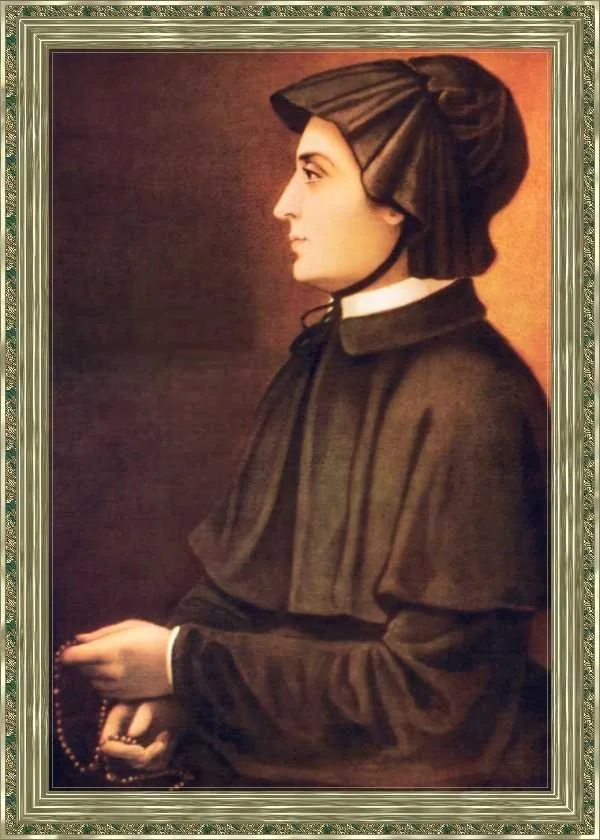
When Saint Elizabeth Ann Seton converted to Catholicism after the death of her beloved husband William, she could never have imagined where that decision would lead. A mother of five children, she eventually became the founder of a new community of women religious.
As Elizabeth grew in her love for Christ and commitment to her Catholic faith, she came to recognize that God was calling her to something more. While she continued to fulfill her responsibilities as a mother, sister, and aunt, her relationship with Christ increasingly became the center around which every other relationship in her life was ordered.
Did she love her children any less?
Of course not. If anything, her love became larger.
The woman who had once cared for five children became a spiritual mother to generations of sisters, students, and families. Her love expanded beyond the boundaries of her immediate family and embraced a much wider world.
And perhaps that helps us understand the difficult words we hear in today's Gospel.
Jesus is not asking us to love our families less. He is asking us to consider what relationship ultimately gives shape and direction to every other relationship in our lives. Because when Christ becomes the center of a life, love does not become smaller. It becomes larger.
In the passage proclaimed this Sunday, Jesus is speaking about discipleship. He is inviting us to consider what—or who—ultimately shapes the way we live and love.
As disciples, we are called to learn from the Master—not simply to admire Jesus from a distance, but to allow his life to become the pattern for our own. Christian discipleship is a lifelong apprenticeship in which we gradually learn to see, love, and live as Christ does. And when Christ becomes the center of a life, something remarkable happens.
The Scripture scholar Sister Barbara Reid writes:
“Think of those most precious to you, such as your parents or your children. Just as your love for them has expanded your heart in such a way that you would do anything for them, even more does love for Jesus fill us to overflowing, so that those who follow him could pour out their very lives for Christ's little ones.”
That image of an overflowing love is important because authentic love enlarges freedom.
Love that diminishes freedom is not really love at all.
And that is precisely what we see in the life of Saint Aloysius Gonzaga. His love for Christ did not make him less human, less loving, or less concerned for others. It made him freer—freer to move beyond privilege, status, and the future others had imagined for him.
Aloysius was the eldest son and heir of one of the most powerful noble families in Italy. As a teenager, he discerned that God was calling him to become a Jesuit. To do so, he would have to renounce his inheritance, his title, and the future that had been carefully planned for him by his family.
This decision led to deep conflict with his father and great pain within his family. Yet Aloysius did not reject his family. He did not stop loving them. In fact, years later he returned home to help reconcile disputes that threatened to tear his family apart.
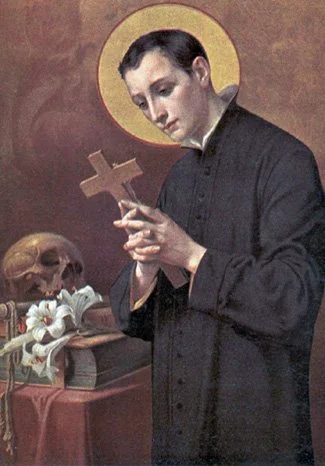
His love for Christ made him freer.
Free to move beyond privilege.
Free to move beyond status.
Free to give himself away.
That freedom became most visible during a plague outbreak in Rome. Seeing a sick man collapse on a Roman street, Aloysius lifted him onto his shoulders and carried him to a hospital.
The heir to one of Italy's most powerful families had learned what it meant to lose his life for the sake of Christ. He contracted the disease himself and died several months later at the age of twenty-three.
His life had become larger than the one that had once been imagined for him. And so had his capacity for love.
Perhaps that is what Saint Paul is speaking about in today's Second Reading when he speaks of walking in “newness of life.” Not simply a change in behavior, but a life transformed by Christ and opened outward in love.
Life in Christ is not smaller.
It is larger.
It is not a rejection of human love.
It is its transformation.
The saints remind us that when Christ becomes the center of a life, our capacity for love expands. We become free to love others more generously, more courageously, and more selflessly.
And so the Gospel leaves us with two important questions:
What relationship stands at the center of our lives?
What would become possible if we allowed our love for Christ to shape every other love?
For Elizabeth Ann Seton, that love became spiritual motherhood.
For Aloysius Gonzaga, it became selfless service.
For each of us, the answer will be different.
But the invitation is the same: To place Christ at the center of our lives and discover that, in him, the heart is always capable of becoming larger than we imagined.
The love of Christ does not diminish the heart, but fills it to overflowing.
O God, who through the grace of adoption
chose us to be children of light,
grant, we pray,
that we may not be wrapped in the darkness of error
but always be seen to stand in the bright light of truth.
Through our Lord Jesus Christ, your Son,
who lives and reigns with you in the unity of the Holy Spirit,
God, for ever and ever. Amen.
-Collect for the Thirteenth Sunday in Ordinary Time
