Fifth Sunday in Ordinary Time (Year A)
Were you afraid of the dark as a child?
Are there little ones (or even “grown-ups”) in your life who can’t stand being left in a room with no lights?
If so, you might be happy to know that science now has some insights to offer.
Centuries and millennia ago, our ancestors lived in a world in which darkness was a time when people were especially vulnerable. In order to stay safe outside of the small ring of light that a fire or, later, a lamp might provide, human beings developed what would become an innate fear of the dark. It’s perfectly reasonable, if we stop and think about what was at stake.
While there have been numerous studies and articles about this in recent years, I like the clear way science writer Josh Hrala summed things up in an article for sciencealert.com: “Our ancestors were constantly on the look-out for predators that wanted nothing more than to chow down on human sandwiches. To make that even scarier, most of these predators hunted at night—a time of day when we are especially vulnerable to attack because of our relatively poor eyesight.” He continues, “Over the years, this nightly fear became instinctual, and we still experience it today as a form of mild anxiety.”
This danger of darkness remained in force until the modern era when street lights and flood lights began to push away the darkness more effectively than anything that we ever had before. But there still remains, in each of us, a certain fear of what may be lurking just beyond the reach of the light or hiding in the shadows.
Ultimately, our fear of the dark is a fear of the unknown.
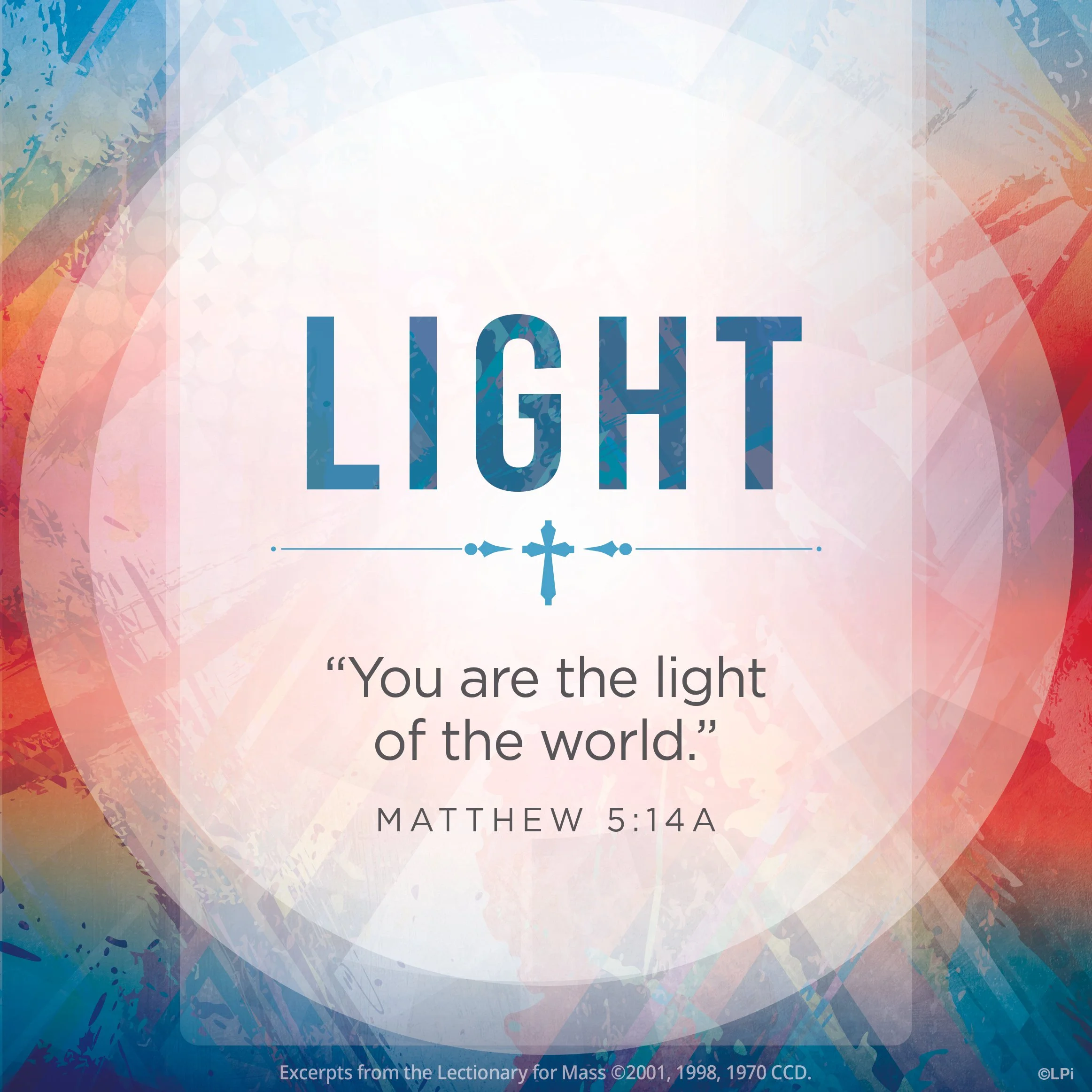
In this Sunday’s Gospel, Jesus uses the image of salt and light to remind his followers of what they—we—are called to be in and for the world. Part of this means that we are called to live lives that, like salt and light, enhance the “flavor” of the world through our witness and service to dispel the darkness of fear and doubt.
I find the images of light—the city on a hill and a lamp on a lampstand—to be particularly salient, given the hard realities of the world today.
The first—the city on a hill—calls to mind a countryside at night. There are no lights on the dark road. Then on a hill in the distance, the traveler sees the lights of a city, and the city becomes a beacon leading the traveler to safety.
In the image of the lamp on its stand, it’s flame is uncovered and held high so that its rays can light up the entire room.
Today, Jesus is revealing for us the intimate connection between what a disciple is and what a disciple does. He teaches us that what we do flows from what we are.
We can bring the light of faith and Gospel-love into the world because our lives have been transformed by the Gospel, and now we ourselves are light for others. We can serve others in various ways only because we have been saved by God’s grace and we become agents of that grace in the lives of others. Our personal renewal—our experience of salvation—becomes the means through which God renews the world.
This is where we find the strength and the courage to make real in our lives what we heard from the Prophet Isaiah in the First Reading:
Share your bread with the hungry,
shelter the oppressed and the homeless;
clothe the naked when you see them,
and do not turn your back on your own.
Then your light shall break forth like the dawn…
If you remove from your midst
oppression, false accusation and malicious speech,
if you bestow your bread on the hungry
and satisfy the afflicted;
then light shall rise for you in the darkness,
and the gloom shall become for you like midday.
Isaiah is telling us what that faith- and Gospel-love-in-action look like, and when we reflect on what he is naming, we can see how these good works have the power to drive away the darkness that divides and denies human dignity—the darkness that makes it easier to fear or dismiss those who are different from us, who don’t speak our language, share our culture, or fit our expectations. That darkness gives space for hatred, racism, despair, and even violence to take root—not only in the world around us, but in our own hearts.
This may all sound larger than life, but it really isn’t. It is the truth about the way God works in the world—and it’s most often through us. And don’t forget that extraordinary things are accomplished through ordinary people. Jesus grew up as the son of a carpenter; some of the apostles were fishermen; Paul was a tentmaker… and we are ordinary people who, like Paul, come to ministry and service in weakness and fear. It is the Spirit and power of God that works the wonders, and God works them through mundane elements of life such as light and salt.
Most of us no longer fear the dark the way we did as children. But we still fear what the darkness represents: uncertainty, loneliness, loss, suffering, and the pain we cannot control. Jesus does not deny that the night exists. Instead, he entrusts us with light. We do not have to be afraid of the dark, because the light we need does not come from streetlamps or floodlights—it comes from Christ living within us. And every time we feed the hungry, shelter the vulnerable, speak truth instead of malice, and choose love over fear, the darkness loses a little more ground.
So no matter how dark the road may feel, we are not walking it without light. We don’t have to be afraid of the dark, because Christ has placed his light within each of us—and he asks us to let it shine.
Keep your family safe, O Lord, with unfailing care,
that, relying solely on the hope of heavenly grace,
they may be defended always by your protection.
Through our Lord Jesus Christ, your Son,
who lives and reigns with you in the unity of the Holy Spirit,
God, for ever and ever. Amen.
-Collect for the Fifth Sunday in Ordinary Time
Prepared for Our Lady of Divine Providence and Old St. Mary’s Churches in Milwaukee, Wisconsin
