Third Sunday in Ordinary Time (2026)
Each of the four Gospels highlights different facets of the life and ministry of Jesus. Scripture scholars tell us that Mark’s Gospel seems to have been written for a largely non-Jewish audience and that Luke’s original readers would have been a Greek-speaking community that included many who were poor and on the margins of society. The Gospel of John is more mystical and theological than the other three and was written for a community of Christians that we more established.
We know that the gospel attributed the Saint Matthew was written for a group of Christians who had maintained a strong sense of their Jewish cultural and spiritual heritage. This is why we find Matthew quoting so often from the prophecies and laws of the Hebrew Scriptures—the Old Testament—as a way to help his audience understand that Jesus was the fulfillment of all the hopes and promises of ancient Israel.
It’s important to keep this in mind as we read the Gospel proclaimed on this Third Sunday of Ordinary Time. Quoting from the Prophet Isaiah, Matthew recounts this prophecy: “Land of Zebulun and land of Naphtali, the way to the sea, beyond the Jordan, Galilee of the Gentiles, the people who sit in darkness have seen a great light, on those dwelling in a land overshadowed by death light has arisen” (Matthew 4:15-16; Isaiah 8:23 and 9:1).
While this reference to the “Galilee of the Gentiles” might seem like an unnecessary detail, it’s actually important that we remember that Jesus began his public ministry in the cities and villages of Galilee, an area that was looked down upon by faithful Jews because it was a region marked by cultural and religious diversity. Saint Matthew is reminding us that Jesus didn’t begin his ministry in the religious and social center of Jerusalem. Instead, Jesus chose to begin his public mission in a place where peoples of different races, cultures, and religions all came together: “Galilee becomes a symbolic place for the Gospel to open to all nations… Jesus teaches us that the Good News, which he brings, is not reserved to one part of humanity, it is to be communicated to everyone” (Pope Francis, Angelus Address, January 26, 2014).
But there is a second part to this Sunday’s Gospel that also deserves our attention: the call of the first Apostles of Jesus.
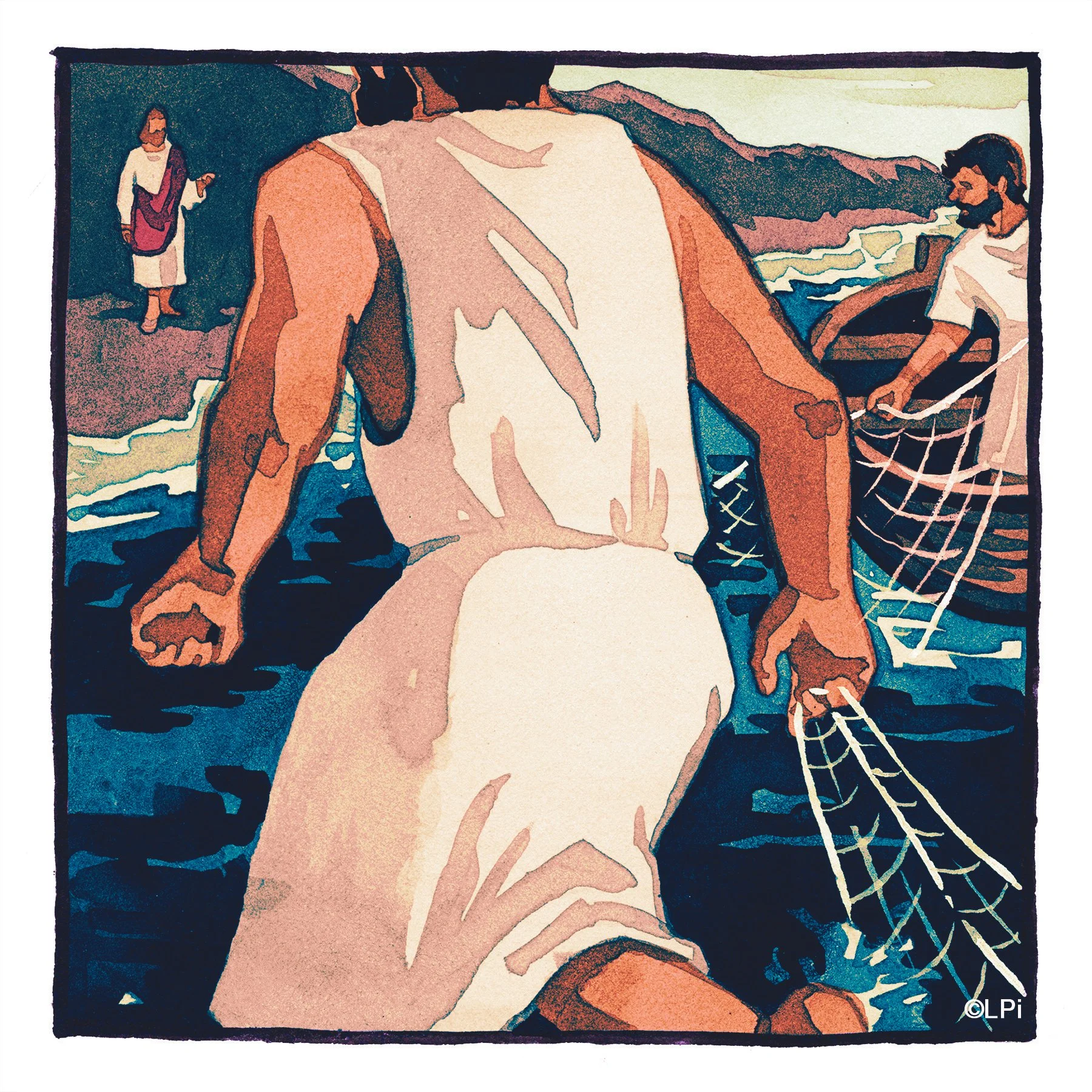
The story we hear about these four brothers leaving behind their fishing boats and their fathers reminds us that following Jesus can require profound changes in our lives and in our relationships with our families and friends. As Sister Barbara Reid, O.P., has observed, “They leave their occupation, though they bring their skills with them to be used in a new way. There are also changes in their family relationships, as the relationship with Jesus and devotion to his mission become their primary focus… Together , Jesus and his disciples spread the light of hope for those who struggle against the despair of disease, illness, and sin” (from Abiding Word).
When we bring these two halves of the Sunday Gospel together, we see how Jesus not only began to proclaim the Reign of God in an unexpected and out-of-the-way place, but he also chose men who, in the eyes of the world, were little more than a rag-tag band of misfits and uneducated tradesmen. These men were certainly not the collaborators and advisors the people would have expected to find traveling with and serving the long-awaited Messiah. And yet, this is how Jesus chose to reveal the beauty and power of the Reign of God.
With this in mind, I want to share these words from an address given by Pope Francis in 2014:
“Dear friends, the Lord is calling today too! The Lord passes through the paths of our daily life. Even today at this moment… He is calling us to go with him, to work with him for the Kingdom of God, in the “Galilee” of our times. May each one of you think: the Lord is passing by today, the Lord is watching me, he is looking at me! What is the Lord saying to me? And if one of you feels that the Lord says to you ‘follow me’ be brave, go with the Lord. The Lord never disappoints.”
The invitation for us this Sunday is to reflect on how Jesus was at work in unexpected ways in his public ministry of healing and forgiving. This work also continues as we seek peace and name injustice (whether it be systemic breakdowns and violence like we’re seeing in Minneapolis and Venezuela or acts of war in terror in Palestine, Iran, or Sudan), looking at the world around us with open eyes and assessing what we see in the light of the Gospel.
As Christians, we believe that the saving work of Jesus continues today, in unexpected ways in our own lives and in the lives of each of his followers. And, like the Apostles—that group of misfits and unlikely followers—each of us is entrusted with the mission of sharing the Good News of the Reign of God through the witness of our lives.
What does it mean for you to know that Jesus is calling you to share in his mission of proclaiming God’s love and mercy?
Almighty ever-living God,
direct our actions according to your good pleasure,
that in the name of your beloved Son
we may abound in good works.
Through our Lord Jesus Christ, your Son,
who lives and reigns with you in the unity of the Holy Spirit,
God, for ever and ever. Amen.
-Collect for the Third Sunday in Ordinary Time
Homily prepared for Three Holy Women Parish in Milwaukee, Wisconsin
