The Fifth Sunday of Lent (2026)
When you were a child, what did you want to be when you grew up?
For many of us, the answer came easily back then. Some children dream of being astronauts or firefighters. Others imagine themselves as teachers, musicians, or athletes. When we’re young, the future feels wide open and full of possibility.
But as life unfolds, things rarely turn out exactly the way we imagined. Education, work, relationships, and responsibilities shape our lives in ways we could never have predicted. Sometimes new opportunities open doors we had never considered. At other times, disappointment, loss, or unexpected change redirects our path. It’s not necessarily about the callings or commitments that shape our lives, but the fears, illusions, and attachments that keep us from living them fully.
Most of us, if we look back, can see that we are not exactly who we once imagined we would become.
And yet beneath all of those changes, there remains a deeper question: Who is the person God is calling us to become?
Many spiritual writers have observed that most of us carry, somewhere within ourselves, an image of the person we hope to become—our truest self, our best self. We imagine someone more generous, more patient, more confident, more free—a person who loves others easily and is less concerned with approval or recognition.
But becoming that person is not only a matter of growth. It also requires letting certain things go.
Over time we begin to recognize the habits and patterns that hold us back: the need to control everything, the tendency to dwell on what is negative, the fear of not being liked or accepted. Sometimes we even carry a quiet sense of shame—memories of mistakes we regret, wounds we carry, or parts of our lives we would rather keep hidden. These patterns can feel deeply ingrained—familiar, even comfortable—but they can also prevent us from becoming the person we are meant to be.
And sometimes the only way forward is to allow those things to die.
That language may sound strong, but if we reflect honestly on our lives, we know that this kind of “death” happens again and again.
Sometimes it comes through life’s transitions: moving to a new place, beginning a new job, entering marriage, welcoming children, or facing the loss of someone we love. At other times it happens more quietly, when we realize that certain attitudes or attachments are keeping us from living fully.
Letting go of those things can feel like a kind of death. We grieve what we are leaving behind. We fear what lies ahead. And yet these moments of loss are often the very places where God begins to create something new within us.
This is why the Gospel we hear today—the raising of Lazarus—is placed before us as we approach the final weeks of Lent.
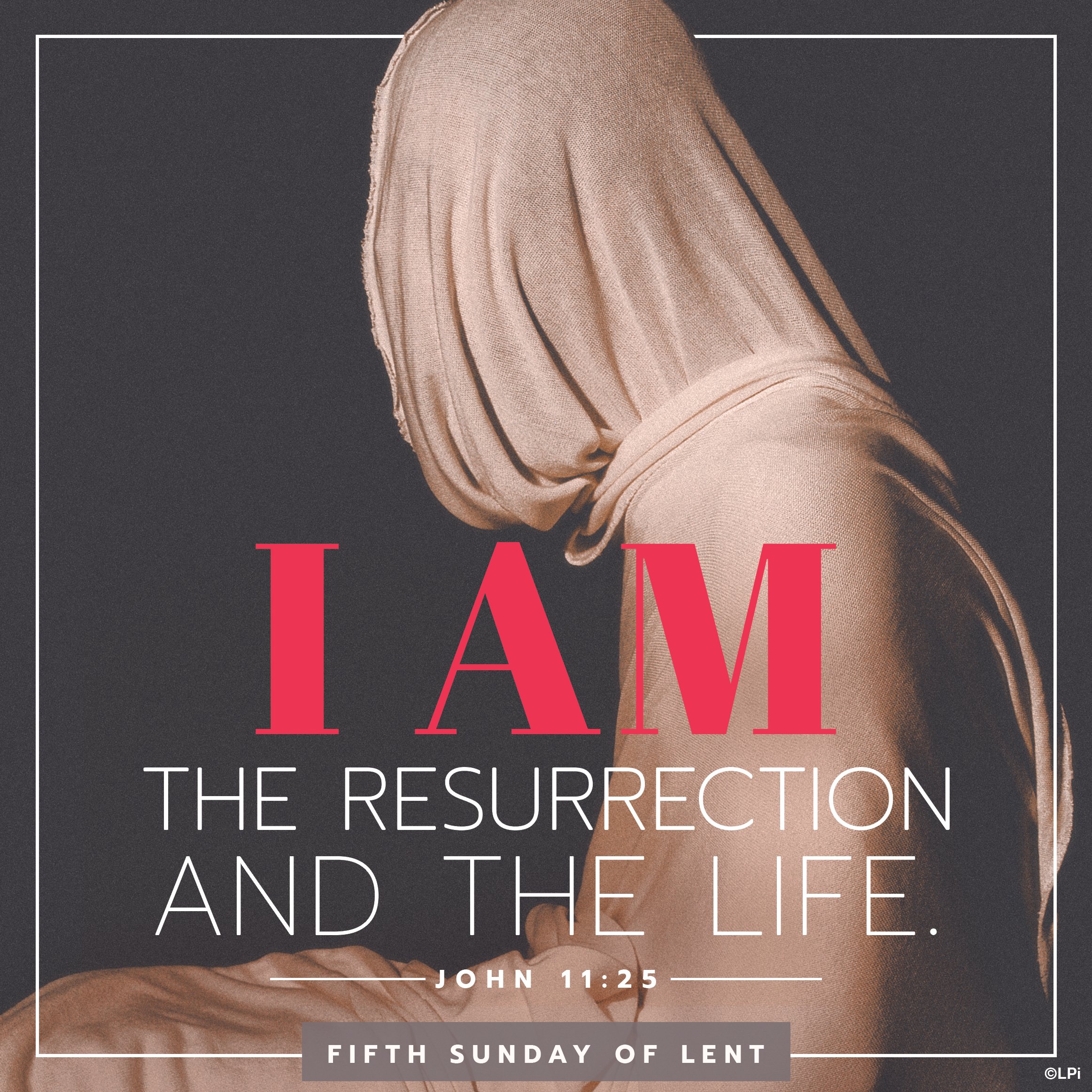
Jesus stands before the tomb of his friend. Lazarus has been dead for four days. The stone covers the entrance, and everyone standing there believes the story has already reached its end.
But Jesus does something unexpected.
He tells the people around him to remove the stone. And then he cries out in a loud voice: “Lazarus, come out.”
And the man who had been dead walks out of the tomb.
It is one of the most dramatic moments in the gospels. But it is not only about what happened to Lazarus long ago. It also reveals something about the spiritual life of every disciple.
Earlier in Lent, we heard the story of the Samaritan woman at the well. There, Jesus spoke about the deep thirst of the human heart—a thirst for meaning, belonging, and the living presence of God.
Last Sunday we heard the story of the man born blind, who, with eyes opened to the light of Christ, came to recognize who Jesus truly was.
And now, in this Gospel, we encounter a third image: not thirst, not blindness, but death itself.
Taken together, these stories trace the journey of the spiritual life:
Christ meets us in our thirst.
He opens our eyes to recognize him.
And he calls us out of the tombs that hold us captive.
Because each of us has places in our lives that can begin to resemble a tomb—places where fear, resentment, shame, or old habits keep us from living fully.
The Gospel reminds us that Christ does not stand at a distance from those places. He stands before them and calls us by name.
But notice something else in the story. After Lazarus comes out of the tomb, Jesus turns to those standing nearby and says:
“Untie him and let him go.”
Even after leaving the tomb, Lazarus is still wrapped in burial cloths. And perhaps that image speaks to our own lives as well. Even as Christ calls us toward new life, there are still things we must gradually loosen and leave behind.
This is part of what Lent is preparing us for.
As we approach Holy Week, the Church invites us to reflect on the “deaths” that have shaped our lives—the sacrifices, changes, and losses that have brought us to where we are today. In many of those moments, we may discover that God was already at work, quietly bringing new life out of what once felt like an ending.
Because the raising of Lazarus is not only about the past. It is a promise.
The God who called Lazarus from the tomb is the same God who continues to call each of us toward life.
In every generation, the voice of Christ still echoes outside the tomb:
“Come out.”
And perhaps the question this Gospel places before us today is a simple one:
Where is Christ standing before the tombs in your life, calling you by name?
And are you ready to step into the new life he is offering?
