Fourth Sunday of Lent (2026)
Have you ever had the experience of recognizing someone in a crowd?
At first all you see are faces and movement—people passing by, shapes and voices blending together. But then something catches your attention: the way someone walks, the sound of their voice, the expression on their face. And suddenly you realize: I know that person.
Seeing, in that moment, is not just about the capacity to look. It’s about recognition.
You can be looking right at someone and still not recognize them until something inside you shifts and the pieces fall into place.
In many ways, that experience helps us understand the Gospel we hear today, which is, fittingly, a story about light.
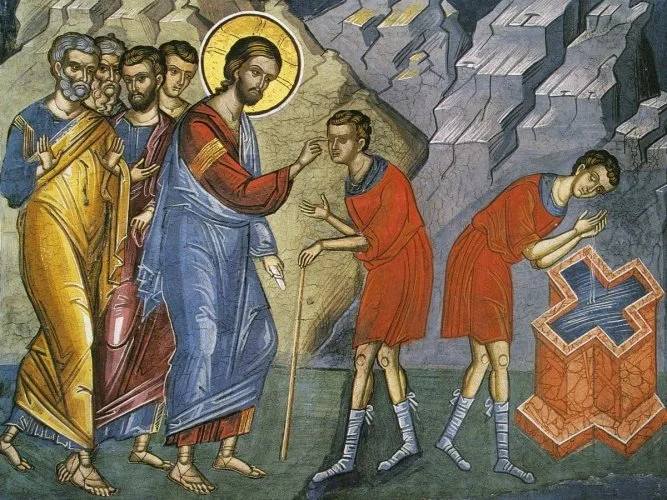
Now, that might be surprising because, at first glance, it seems like a story about physical sight. Jesus heals a man who has been blind from birth. For the first time in his life, this man is able to see—the people of his community, the beauty of the world around him, and, most importantly, the face of the Savior standing right before him.
But John’s Gospel is never only about what happens on the surface.
In John’s Gospel, blindness is not simply the inability to see with the eyes. It is the inability to recognize what God is doing right in front of us.
And that is where the story becomes especially significant.
On the one hand, there is the man who has been blind from birth. Without seeking Jesus out or asking for healing, he suddenly receives the gift of sight. On the other hand, there are the people around him—the crowd, the religious authorities, the observers who believe they understand exactly what God is doing. They believe they can see clearly.
And yet, as the story unfolds, it becomes clear that the real blindness in this Gospel is not the blindness of the man who was healed. Instead, it is the blindness of those who refuse to recognize the Truth standing right in front of them.
After hearing Jesus speak about blindness and sight, the Pharisees respond defensively:
“Surely we are not also blind, are we?”
And Jesus answers them in a way that is both striking and unsettling:
“If you were blind, you would have no sin; but now you are saying, ‘We see,’ so your sin remains.”
What Jesus is naming here is something that can happen to all of us.
When we become convinced that we already understand everything—that we have all the answers, that our perspective is complete—we can lose the ability to recognize how God is still at work in our lives and in the world around us. The danger is not that we do not know enough about God. The danger is that we think we already know everything we need to know.
And in a world filled with noise, strong opinions, and constant arguments about what is true, that kind of spiritual humility can be surprisingly difficult.
And when that happens, we can be looking directly at Christ and still fail to recognize him.
The man born blind, however, approaches things very differently.
He does not begin with certainty or control. Instead, he is simply open.
When Jesus places mud upon his eyes and tells him to wash in the pool of Siloam, the man obeys. He allows himself to trust the strange and unexpected action of Jesus. When he washes, his eyes are opened—and the early Church quickly saw in that moment an image of baptism, when our own eyes are opened to the light of Christ.
But the story does not end with the miracle.
As the man begins to speak honestly about what has happened to him, the religious leaders grow increasingly hostile. They question him, challenge him, and finally reject him altogether. In the end, they throw him out.
And then something remarkable happens—Jesus goes looking for him.
This man who had once been essentially invisible—overlooked, dismissed, and cast aside—is now the very one Jesus seeks out and stands before. For the first time in his life, someone truly sees him. And when that happens, his sight becomes faith.
We see this as the story unfolds and the man grows in understanding. At first he simply refers to Jesus as “the man called Jesus.” Later he speaks of him as “a prophet.” And finally, when Jesus reveals himself more fully, the man responds with the deepest confession of faith in the Gospel: “I do believe, Lord.”
What began as the healing of his sight has become something much greater—the awakening of faith.
And that is precisely why the Church places this Gospel before us during the Season of Lent.
The rose color of this Laetare Sunday reminds us that we are now more than halfway through the journey toward Easter. This is a good moment to pause and reflect on how this season has been shaping us.
Are our Lenten penances helping us see more clearly?
Are our sacrifices helping us recognize where God is already at work in our lives?
Or are there places where we may still be tempted toward a kind of spiritual blindness—relying only on our own knowledge, our own abilities, or our own plans rather than trusting in the grace of God?
The witness of the man born blind offers us encouragement here.
Once his sight is restored, he does not hide what has happened to him. Even when others question him, challenge him, and doubt his story, he speaks openly about what Jesus has done.
His sight becomes a testimony.
And perhaps that is the invitation this Gospel offers to us today.
As our eyes are gradually opened through prayer, conversion, and the quiet working of God’s grace, we too are called to bear witness—to allow the light of Christ we have received to shine in the way we live, the way we speak, and the way we love.
Because in the end, the miracle in this Gospel is not simply that a blind man received his sight. The deeper miracle is that someone learned to recognize the Christ in front of him.
And that is the same work Christ continues to do in us as we journey toward the light of Easter—opening our eyes, little by little, until we learn to recognize him.
