Second Sunday of Lent 2026
In her Revelations of Divine Love, the medieval mystic Blessed Julian of Norwich wrote:
I saw Him and still sought Him,
For we are now so blind and so unwise that we never seek God
until He of His goodness shows Himself to us;
and when we see anything of Him by grace, then are we moved by
the same grace to try with great desire to see Him more perfectly.
And thus I saw Him and I sought Him,
and I possessed Him and I lacked Him.
And this is, and should be, our ordinary behavior in life.
These words describe not only mystical experience, but the ordinary rhythm of faith itself. Unlike Dame Julian and other mystics who experience the reality of God’s presence in a unique way, we are often very quick to try to note the distinctions—the boundaries—between the human and the divine. Even our ways of talking about God can make the divine realities seem far-removed from our daily lives. The Church’s greatest minds and grace-filled mystics have understood that our limited human perspectives, especially our words, fail us when we are allowed even the slightest glimpse of the glory of God.
The Gospel proclaimed on this Second Sunday of Lent gives us one such moment of glimpse and longing in the story of the Transfiguration of Jesus.
It’s easy to imagine Saint Matthew struggling with the limits of language as he recalled what happened on the mountain that day as Jesus made his way to Jerusalem. The Transfiguration comes at a moment when the road ahead has just been named, and it is not an easy road.
In his gospel, Matthew places the Transfiguration immediately after the first “prediction of the Passion”--when Jesus told his disciples that “he must go to Jerusalem and suffer greatly from the elders, the chief priests, and the scribes, and be killed and on the third day be raised” and that whoever wishes to come after him must “deny himself, take up his cross, and follow.” What Matthew is presenting for us are the competing images of darkness and light, of death and life. In other words, the light of the mountain comes at a moment when darkness has just been named.
We get the sense, that for Matthew the light of the Transfiguration was allowed to shine forth so that the shadow of the Cross wouldn’t overwhelm the disciples who struggled to make sense of what Jesus was saying about what lay in store for him in Jerusalem. We need this same reassurance. When the road ahead feels uncertain, when the path of faith leads us into places we would rather avoid, what we most need is not an escape, but the confidence that God does not abandon us on the way.
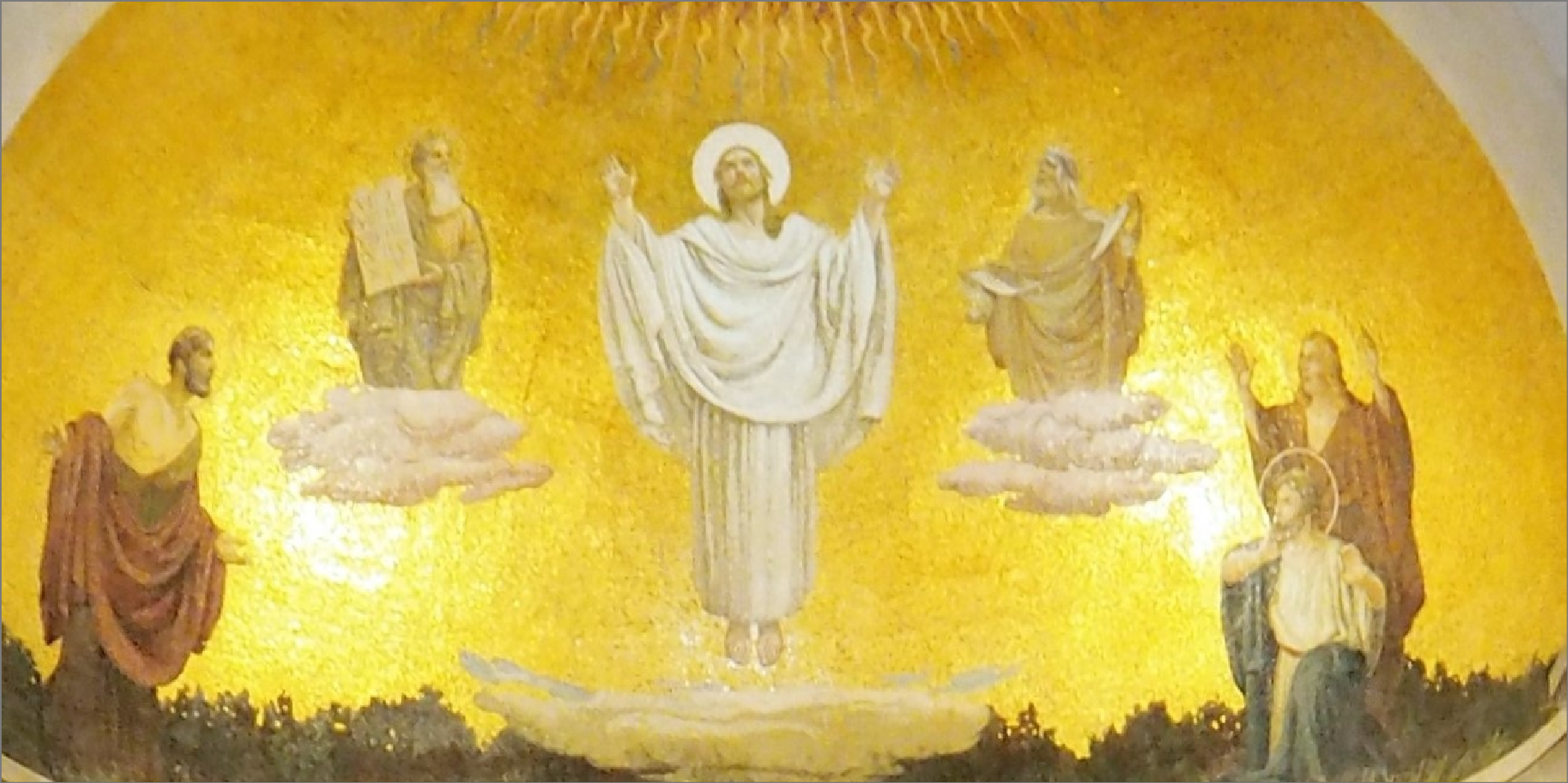
The Gospel itself reinforces this assurance of God’s presence.
The cloud a sign of God’s presence; Moses and Elijah, representing the Law and the Prophets, bear witness to all that had promised, encouraging Jesus to continue his journey. And so, in the Transfiguration, Jesus is empowered to continue his journey and mission, knowing that regardless of what lies ahead his Father remains with him, guiding his steps and making his mission bear fruit.
And this is where the mystery of the Transfiguration touches our lives most directly. But the light we glimpse on the mountain is not meant to be hoarded or kept for ourselves. The Transfiguration is not only about what God reveals to us in Christ; it is also about how we are changed for the sake of others.
When we come down from the mountain with Jesus, we return to families that are imperfect, communities that are strained, and a world marked by suffering and division. The vision of Christ’s glory reshapes how we see one another—not as problems to be solved or burdens to be endured, but as persons who, like us, are loved by God and in need of mercy. Lent forms us not only to endure our own valleys with faith, but to walk with others in theirs, carrying the light of Christ into places of darkness through patience, compassion, forgiveness, and quiet acts of love.
The mystery of the Transfiguration reminds us that God does not reveal glory in order to spare us the journey, but to strengthen us for it. Peter wants to remain on the mountain, to preserve the moment, to build tents and stay in the light. But the Gospel is clear: the vision is given so that they can come back down the mountain and follow Jesus into the places of suffering, misunderstanding, and sacrifice.
Lent offers us a similar grace. It is a season of light given to us not as an escape from the demands of discipleship, but as a way of seeing more clearly who Christ is and who we are called to become. Most of us will not be granted dazzling visions, but we are given quieter moments of clarity—moments that shape how we return to the valleys of daily life: to difficult conversations, to strained relationships, to the steady work of loving when it would be easier to withdraw.
Like Julian of Norwich, we may find ourselves seeing God and still seeking God, possessing God and yet longing for more. This is the ordinary rhythm of faith. The invitation of this Second Sunday of Lent is not to cling to the mountain, but to let what we glimpse there shape the way we walk through the valleys. We descend with Christ, trusting that the light we have seen—even faintly—will be enough to guide our next faithful step.
O God, who have commanded us
to listen to your beloved Son,
be pleased, we pray,
to nourish us inwardly by your word,
that, with spiritual sight made pure,
we may rejoice to behold your glory.
Through our Lord Jesus Christ, your Son,
who lives and reigns with you in the unity of the Holy Spirit,
God, for ever and ever. Amen.
Collect for the Second Sunday of Lent
Homily prepared for Old St. Mary’s Church, Milwaukee, Wisconsin
