Solemnity of the Most Holy Body and Blood of Christ (2026)
In 1928, Myles Connolly published a small novel entitled Mr. Blue, which tells the story of a young man who decides to live out the Christian Faith in a serious, transforming way. The book was intended to serve as a Christian response to F. Scott Fitzgerald’s classic work The Great Gatsby. Like the characters in Gatsby, Blue lives a life of extremes—we might even say of excess—but it is a far cry from the extravagance of the “Roaring ‘20s.” His excess is one of joy, generosity, faith, and self-giving love.
Mr. Blue has become a classic of twentieth-century Catholic fiction and it has much to say to us about how faith in Christ can shape a life and transform a person’s very existence into an act of eucharistia—an act of thanksgiving—that by its very nature draws others into communion.
In the novel, the character of Blue tells a story… and it’s a story about the kingdom of the Antichrist. In the story, the days of the “ecstatic, passionate, beauty-loving, liberty-seeking people had… come to a close.” Humanity had become cold and spiritually exhausted. Joy, beauty, laughter, and even curiosity had disappeared.
And, at the climax of Blue’s story, a priest—the last Christian—climbed the highest tower in a city of metal and, using hosts made from wheat he had grown himself, offered the last Mass, fulfilling a promise that the priest had made to “bring God back to the earth.”
As the government’s forces prepared to destroy the priest high atop the tower using planes and bombs, the priest began to repeat the words of Christ at the Last Supper.
And now, I am quoting Blue’s story:
One plane is now low over the roof of the tower, so low that the crew can make out the figure of the cross on the priest’s chasuble. A bomb is made ready…
And now the priest comes to the words that shall bring Christ to earth again. His head almost touches the altar: Hoc est enim corpus meum…
The bomb did not drop. No. No. There was a burst of light beside which day itself is dusk. Then a trumpet peal, a single trumpet peal that shook the universe. The sun blew up like a bubble. The stars and planets vanished like sparks. The earth burst asunder… And through this unspeakably luminous new day, through the vault of the sky ribbed with lightning came Christ as he had come after the Resurrection.
This image of a lone priest standing atop a tower in a burned-out world from which even the most basic expressions of joy, beauty, and human freedom had disappeared is a powerful one.
It’s an image that certainly has something to say to us on this Solemnity of the Most Holy Body and Blood of Christ.
But the power at work here isn’t in the drama of bombs and planes or even in the revolutionary act of the priest. What’s important here is the reminder the story offers us about the expansive power of the Eucharist.
Yes, in the Mass—the celebration of the Eucharist—Christ comes to us to offer us the gift of himself under the form of bread and wine.
Alongside that truth is another, equally important truth: in the celebration of the Eucharist, we are caught up in the life and love of God in a way that transcends any personal acts of devotion and adoration. This is because in the Eucharist, our encounter with Christ reveals how God’s life and love are expansive, always self-giving, and always oriented toward others.
Our sharing in the “One Bread” and “Cup of Blessing” is an act of communion in the fullest sense—a communion that brings us not only into the life of Christ, but a communion that unites us with one another.
The Eucharist brings us out of ourselves.
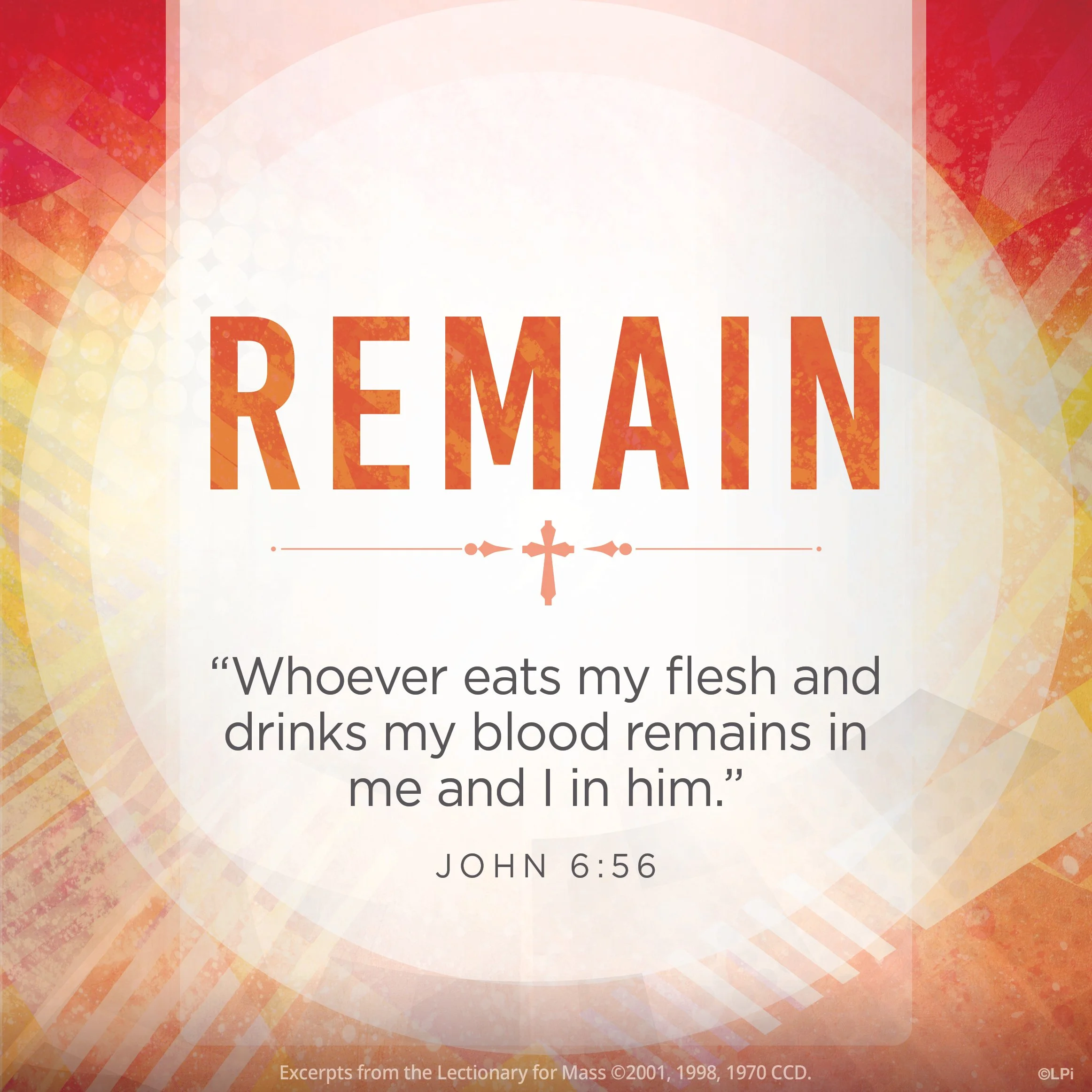
And this matters because, in today’s Gospel, Jesus does not speak about the Eucharist merely as a symbol or remembrance. He speaks about it as participation in his very life: “Whoever eats my flesh and drinks my blood remains in me and I in him.”
The Eucharist is Christ giving himself to us completely so that his life might become our life. The life he shares with us is nothing less than the life of God itself—a life—a reality—that enters every place of human hunger: our loneliness, our losses, our poverty, our desire to belong, and our longing to know that we are loved.
And that changes us.
Because communion with Christ is never something closed in on itself. The more deeply we enter into the life of Christ, the more we are drawn outward in love toward others.
In a reflection offered on this Solemnity in 2022, Pope Francis offered these words:
“Sometimes, there is the risk of confining the Eucharist to a vague, distant dimension, perhaps bright and perfumed with incense, but distant from the straits of everyday life. In reality, the Lord takes all our needs to heart… Our Eucharistic adoration comes alive when we take care of our neighbor like Jesus does.”
The Eucharist teaches us that adoration and love of neighbor can never be separated.
There is hunger for food all around us.
There is hunger for companionship.
There is hunger for consolation.
There is hunger for meaning.
There is hunger for beauty—for the kind of beauty that reminds us that life is more than utility or survival.
And there is hunger simply to know that there is a place for us—that each of us is seen and loved... and that none of us is alone.
Christ’s Presence in the Eucharist—and his attention to our needs—becomes an invitation for us to notice and respond to the hungers of the world around us.
Even as we are invited to “come and eat,” we are also being invited to feed others.
This feast asks us whether we are truly open to the expansive life Jesus offers us in the sacrament of his Body and Blood. Because the promise of the Eucharist is not simply that Christ comes to us. It is that Christ remains with us… so that we might learn to remain in him.
O God, who in this wonderful Sacrament
have left us a memorial of your Passion,
grant us, we pray,
so to revere the sacred mysteries of your Body and Blood
that we may always experience in ourselves
the fruits of your redemption.
Who live and reign with God the Father
in the unity of the Holy Spirit,
one God, for ever and ever. Amen.
-Collect for the Solemnity of the Most Holy Body and Blood of the Lord
Prepared for Ss. Peter and Paul Church, Milwaukee, Wisconsin
