When we hear the word “kingdom,” most of us think of a place: a territory with boundaries, a people, and a ruler. And when we celebrate the Solemnity of Christ the King, it is easy to imagine that we are simply honoring Jesus as the ruler of some distant heavenly kingdom.
But the Reign of God that Jesus proclaimed is about something much more than a place. It’s not some sort of geographical reality, like a domain that can be charted on a map.
The Reign of God is something that happens.
The Reign of God—the “Kingdom of Heaven”—is God’s presence and power at work in the world, bringing about justice, mercy, healing, and peace.
In that sense, the Reign of God is more a verb than a noun. It is an ongoing reality that we are invited to recognize, welcome, and help bring about.
A few years ago, I had an opportunity to experience this celebration in a very different context: with a Protestant community celebrating what they called “Reign of Christ” Sunday. That expression offered me a new perspective on this feast and what it might mean for us. It shifted my attention from simply celebrating Christ as King to considering what it means to live under his reign and to participate in the work of God's Kingdom.
And that is something for us to keep in mind when we think about the origins of this feast… When Pope Pius XI instituted this solemnity in 1925, fascism was on the rise. Pius was grieving for a world ravaged by the First World War and which was increasingly placing its trust in the “lords” of exploitative consumerism, nationalism, and new forms of injustice. Old power structures were fading, new ideologies were emerging, and a new and uncertain world was taking shape.
Pope Pius wanted to remind Christians that those passing empires and earthly powers could not define who, or whose, they were. Our ultimate allegiance belongs to Christ. In his encyclical Quas primas, he described the Kingdom of Christ as “spiritual and concerned with spiritual things.” It demands of its subjects “a spirit of detachment from riches and earthly things, and a spirit of gentleness.”
That is a very different understanding of kingship from what we usually associate with earthly rulers. And the Scriptures today help us understand what this looks like.
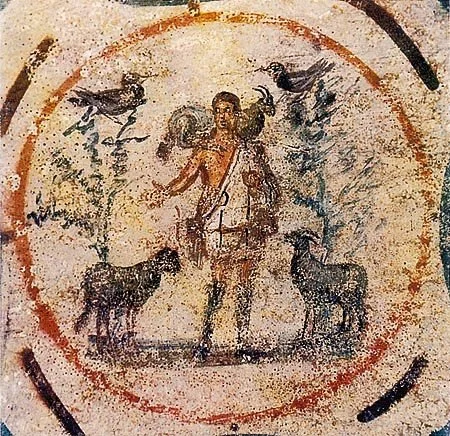
In the First Reading, the prophet Ezekiel offers us a beautiful image of God as a shepherd who gathers the scattered, searches for the lost, and tends to the wounded: “As a shepherd tends his flock when he finds himself among his scattered sheep, so will I tend my sheep” (Ezekiel 34:12). What a vision! And this is especially meaningful, as we continue to grapple with the reality of violence, fear, and suffering in our world. The King we celebrate is not one who stands above his people demanding service, but one who draws near to care for them.
And this has implications for how we understand our own identity. Through Baptism, we have been claimed by and for Christ. Our true home is in the Reign of God, a reality that surpasses the limits of national boundaries, ethnicities, political affiliations, and even time itself. We are co-citizens of God's Kingdom, together with all the Communion of Saints.
But what does it mean to be a citizen of this Kingdom? What does our allegiance to Christ actually ask of us?
The Gospel gives us a very concrete answer. Jesus tells us that when he comes in glory, he will separate the nations as a shepherd separates sheep from goats. And the measure of judgment is surprisingly simple: Did you feed the hungry? Give drink to the thirsty? Welcome the stranger? Clothe the naked? Care for the sick? Visit those in prison?
Jesus identifies himself with those who are most vulnerable. Whatever we do for them, we do for him. And whatever we fail to do for them, we fail to do for him.
This is where the celebration of Christ the King becomes more than a beautiful title or a solemn hymn. The Kingdom of Christ is not some far-off reality that we simply await. We are living in that Kingdom now, and we are called to make it visible through the way we treat one another. Our citizenship in God's Kingdom places a responsibility upon us: to recognize Christ in those who suffer, to work for justice, and to bring relief and compassion to those who are most in need.
The Spanish theologian José Antonio Pagola offers a helpful reflection on this when he writes that Jesus was “proclaiming an event” rather than simply teaching a religious doctrine. Jesus wanted people to embrace God so that “God’s reign of justice and mercy would become ever wider and more joyful.” His mission was to hasten the coming of God's Reign, a Reign characterized by “life, justice and peace.”
That is the vision we celebrate today. And it is also the work entrusted to us.
We cannot claim Christ as our King while remaining indifferent to the suffering of those around us. We cannot celebrate his Reign while ignoring those who are hungry, excluded, forgotten, or treated unjustly. The humility and compassion of our thorn-crowned King must become visible in our own lives.
Pope Pius XI established this feast at a time when earthly powers were claiming people’s allegiance and identity. A century later, those claims are still with us. Our nation, our political convictions, and the causes we serve may matter deeply, but none of them can claim the place that belongs to Christ. We have been claimed by him and made citizens of a Kingdom that reaches beyond every border and division. Our deepest identity is not defined by the powers that divide us, but by the Christ who claims us—and his Reign is made visible wherever the hungry are fed, the stranger welcomed, and no one is forgotten.
Almighty ever-living God,
whose will is to restore all things
in your beloved Son, the King of the universe,
grant, we pray,
that the whole creation, set free from slavery,
may render your majesty service
and ceaselessly proclaim your praise.
Through our Lord Jesus Christ, your Son,
who lives and reigns with you in the unity of the Holy Spirit,
God, for ever and ever. Amen.
-Collect for the Solemnity of Our Lord Jesus Christ, King of the Universe
