The Fourth Sunday of Advent (2025)
The Gospels do not relate a single word spoken by Joseph, the husband of Mary. And yet, there he is—a silent, protective presence standing in the shadows of Advent who comes into view only in the final days of this season of watching and waiting.
Although our Catholic Tradition has honored Joseph with different titles and devotions over the centuries, the story related in this Sunday’s Gospel focuses on a very particular aspect of Joseph’s character: his obedience.
As we know, obedience isn’t a particularly welcome or easy concept, and yet there is something fundamental about obedience for us who are followers of Jesus.
Taken from the Latin words ob and audire, our English word “obedience” can simply mean to listen or to hear… but there is more to it, because in its fullest sense it means to listen with the heart. It is a kind of listening can’t be reduced to simply taking in and then acting on the commands of another person. (That is submission.) Instead, obedience is about a quality of attentiveness, awareness, and intentionality that is grounded in relationships.
To say it another way, to be obedient as a Christian is to say, “I love you so much and am so in tune with your needs and desires that words are unnecessary... I hear you… I see you.” We can think of spouses and partners who have been together for several years and who can anticipate each other’s needs or of a parent who knows what their child is feeling without any words ever having been spoken.
As I said: obedience, in its truest sense, isn’t about submission to the will of another. Obedience is about relationships.
And when think of Joseph, we see that he listened, yes, but, more than that, he listened with his heart.
The Gospel refers to Joseph as a “righteous man,” which means that he would have been a devout observer of Jewish law and tradition. In that time and place, betrothal—a period lasting about a year—was considered a legal arrangement that conferred on the couple the status of marriage. The woman remained in her family home until the public ceremony, when the man came in procession to bring her into his own home. Their union was usually consummated after this. At that time, the man and the woman were given the titles of “husband” and “wife,” and the commitment and fidelity associated with those titles were expected of them. In fact, infidelity on the part of the woman was regarded as adultery.
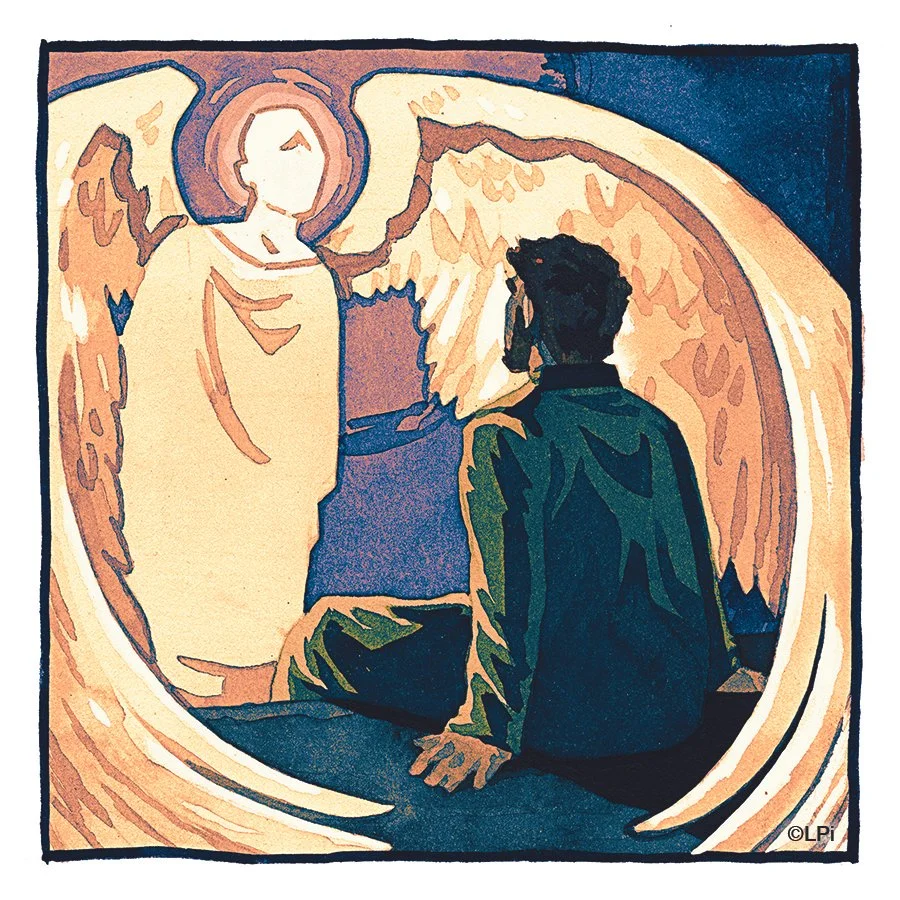
When it became clear that Mary was carrying a child, Joseph was faced with a dilemma. Since the child was not his, it would appear that Mary had committed adultery and, according to the Law, she should be stoned to death (cf. Deut. 22:23-24). But righteous Joseph decided to divorce Mary rather than expose her to shame. But it is at this point in the story that we see the flowering of Joseph’s obedience… rather than simply submit to the Law, his listening heart—his faith-filled obedience—recognized truth in what the divine messenger reported to him and he moved forward with the marriage to Mary and this made the coming child his legal son.
Joseph models for us the kind of obedience that we Christians are called to in our relationship with God and with one another. It is this kind of obedience that opens us up to newness and to what is possible for God, for whom “nothing is impossible.”
These Advent days are days of hope, expectation, waiting, perseverance, and, yes, obedience. Because, like Joseph and Mary who both said “yes” to what was asked of them, God has also been asking something of us in these Advent days.
And what is it God is asking?
The obedience of faith (cf. Romans 1:5).
In an Advent reflection she wrote in 1966, the author and activist Dorothy Day had this to say about obedience and faith:
Faith is required when we speak of obedience. Faith in a God who created us, a God who is Father, Son, and Holy Spirit. Faith in a God to whom we owe obedience for the very reason that we have been endowed with freedom to obey or disobey. Love, Beauty, Truth, all the attributes of God which we see reflected about us in creatures, in [our very works,] whether it is bridges or symphonies wrought by [our] hands, fill our hearts with such wonder and gratitude that we cannot help but obey and worship.
Like Saint Joseph, each of us being called to trust that what God has promised to us will be given to us. Beyond this, however, we are also being called to make real in our lives that obedience—that listening with the “ear of the heart”—that Saint Joseph embodied. It was that obedience that enabled him to navigate the fears and frustrations he must have experienced because of Mary’s pregnancy or the angel’s command. It was the obedience of faith that allowed those fears and frustrations to give way to that love and an openness of mind and heart, allowing him to see with the eyes of faith the Gift that God was preparing for him and for all the world.
This same grace is being offered to us us on this Fourth Sunday of Advent, if we are also able to offer our “yes” to God. Our faithful obedience, like that of Joseph, has the power to create the space for Christ to be born anew in us as “God-with-us.”
Pour forth, we beseech you, O Lord,
your grace into our hearts,
that we, to whom the Incarnation of Christ your Son
was made known by the message of an Angel,
may by his Passion and Cross
be brought to the glory of his Resurrection.
Who lives and reigns with you in the unity of the Holy Spirit,
God, for ever and ever. Amen.
-Collect for the Fourth Sunday of Advent
Homily prepared for Ss. Peter and Paul Church in Milwaukee, Wisconsin
