The Fourteenth Sunday in Ordinary Time (2026)
Over the past several weeks, I've found myself thinking a great deal about expectations.
That's probably inevitable whenever someone begins a new ministry. A new pastor arrives with certain expectations about the parish. Parishioners have expectations about their new pastor. Some of those expectations will be fulfilled. Others will change with time as we come to know one another.
The truth is, there comes a moment in every person's life when we discover that reality doesn't always match our expectations.
We discover it in marriage. We discover it when we become parents. We discover it when we begin a new job, retire, receive an unexpected diagnosis, or watch life unfold in ways we never could have imagined. Expectations can be good. They help us make plans, set goals, and navigate the future. But life has a way of throwing curve balls.
Life has a way of humbling us and inviting us to revise our expectations.
The same is true of our relationship with God.
We all have expectations of God. Sometimes those expectations are expressions of faith. At other times—when we're not at our best—they have more to do with how we think the world ought to work.
Who is it that I expect God to be for me?
What happens when God doesn't meet my expectations?
What are my expectations for God even based on?
Those are not new questions. They are as old as faith itself.
Certainly, our spiritual ancestors—the People of Israel—wrestled with these questions.
Countless times in psalms, in the writings of the Prophets and the wisdom writings of the Hebrew Scriptures we hear these expectations expressed in rich images: “shepherd”… “potter”… “mother bear”… “king”… “rock”… “consuming fire” are just a few examples. Each of these symbols, these names of God, holds within it a universe of meaning and expectations about who and what God was for them. But of all these images and understandings of God, the one that resonated most strongly throughout Israel’s later history was that of “Messiah.”
The Chosen People longed for the coming of the Messiah—the Anointed One of God—who would make all things right. At the heart of this longing was hope and a desire for justice. They dreamed of a day when the poor would prosper, the sick would be healed, and freedom and peace would replace suffering and oppression.
And this vision—this hope—makes sense.
Think about life today. Think about when we feel challenged and overwhelmed, about those times when the world isn’t the way we think it should be, or when we’re confronted with suffering.
Aren’t there moments when we also want a god who flexes his muscles and simply takes away our problems; who silences those who don’t agree with us? Aren’t there times when we wish a savior would magically remove all the challenges and disappointed expectations we feel?
But then we have this Sunday’s Reading from the Prophet Zechariah. And the picture he paints is surprising: “See, your king shall come to you,” the prophet promises: “a just savior is he, meek and riding on an ass.”
This isn’t who or what the people would have been looking for.
Where were the demonstrations of royal power?
Where were the war horse and the warrior’s bow?
Talk about disappointed expectations!
And yet, this meek king would banish chariots and proclaim peace to the nations!
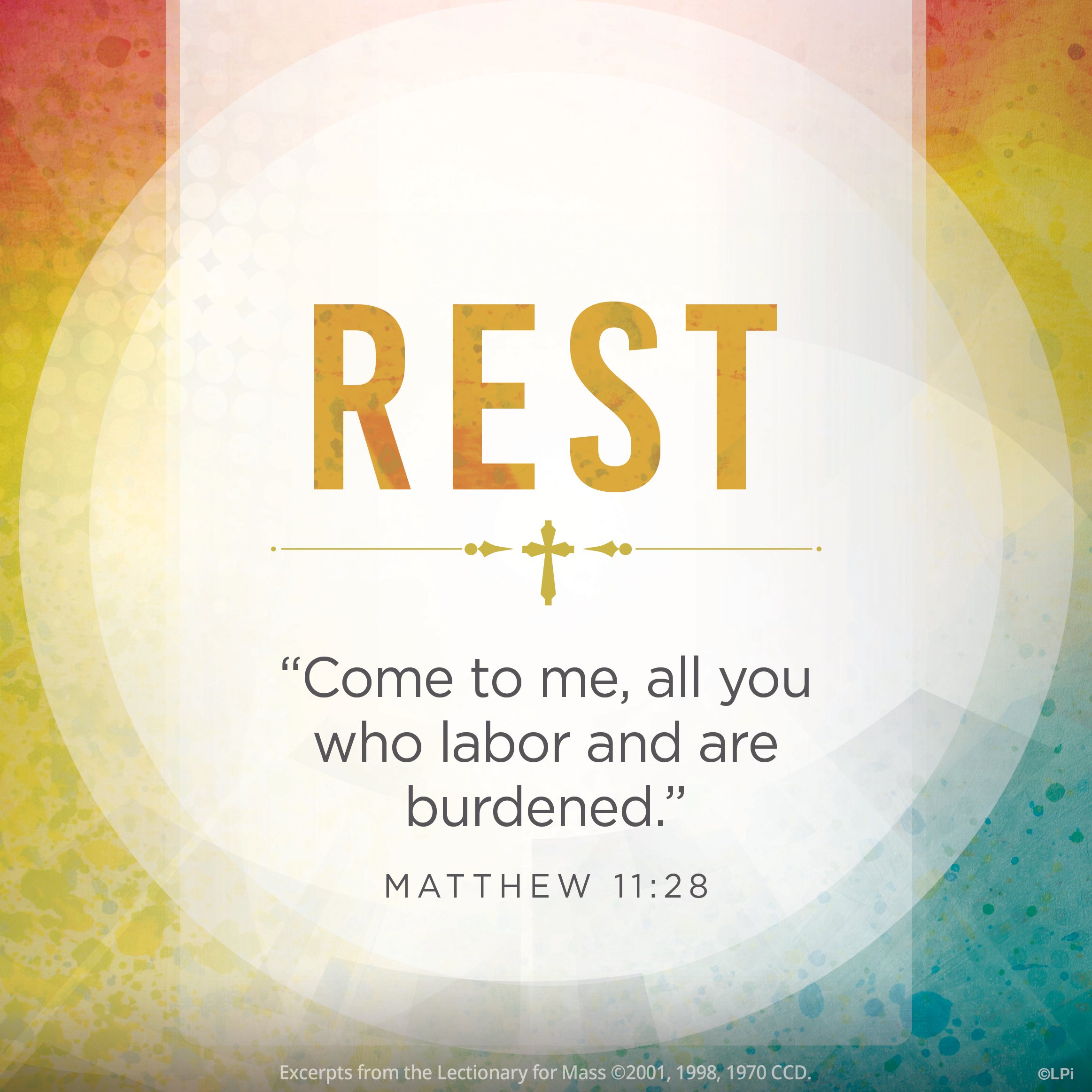
That promise finds its fulfillment in Jesus. Not through demonstrations of power or force, but through the quiet strength of a love that enters into the burdens of the human heart. Because, in the Gospel, Jesus isn’t denying the very real demands of faithful discipleship or that life, itself, can wear us down.
“Come to me,” he says, “all you who labor and are burdened.” And he promises rest.
This is where the meekness of Jesus becomes real for us.
Rather than simply remove the struggles, the sacrifices, and the disappointments we face, he promises to be with us in those moments. This is why Pope Francis could reflect: “Today, Jesus says to each one [of us]: ‘Take courage; do not give in to life’s burdens; do not close yourself off in the face of fears and sins. Come to me!’”
This Jesus, who is “meek and humble of heart,” doesn’t magically resolve the problems of life.
Rather—and this is essential—he opens his heart to embrace the heaviness that we carry in ours.
He doesn't promise that we will never be weary. He promises that we will never carry our burdens alone.
He doesn’t take away our cross; he labors with us.
This is how burdens become light: He carries them with us.
This Sunday, it isn’t a question of letting go of our expectations of how God should act—It is to discover that the Savior given to us is infinitely greater than the "savior" we might imagine, especially when life leaves us tired, burdened, or disappointed.
The Savior revealed to us in Jesus is not the one who conquers by force or overwhelms us with displays of power.
He is the One who says, "Come to me."
He is the One who is meek and humble of heart.
The One who carries with us what we cannot carry alone.
And he continues to draw near to us: in the Scriptures proclaimed, in the Eucharist we share, in the life of this community, in the embrace of a friend, in the kind smile of a stranger.
Christ—the Savior—walks with us.
And today he is inviting us to discover that—even in those moments when life disappoints us—we are never alone.
O God, who in the abasement of your Son
have raised up a fallen world,
fill your faithful with holy joy,
for on those you have rescued from slavery to sin
you bestow eternal gladness.
Through our Lord Jesus Christ, your Son,
who lives and reigns with you in the unity of the Holy Spirit,
God, for ever and ever. Amen.
-Collect for the Fourteenth Sunday in Ordinary Time
Homily prepared for St. Pius X Parish in Wauwatosa, Wisconsin
