The Eleventh Sunday in Ordinary Time (2026)
In an interview he offered several years ago, Father Tom Smolich, the international director of Jesuit Refugee Service, remarked that he has come to see the world’s refugee crisis as “a problem of the heart.” Father Smolich spent years directing this non-profit that supports refugees and displaced persons in 59 countries, and he shared that this crisis is more than just a “humanitarian problem” of getting resources to the people who need them. The indifference of so many governments and international organizations—even as the number of refugees and refugee deaths increases—reflects a spiritual crisis… an inability to feel compassion.
That is a powerful insight. And honestly, it reaches far beyond the realities surrounding migrants and refugees.
Think about the pain, the conflicts, the tragedies that fill our social media feeds and news outlets… the cruelty that sometimes passes for public conversation, the suspicion we show toward those who are different from us, the ways people can be reduced to labels, categories, or stereotypes. So many of the issues—and so much suffering—that we face locally and internationally often come down to that lack of compassion.
Compassion.
It’s a beautiful and terrible word.
Although most of us think of “compassion” as something like kindness or sympathy, the origins of the word are much richer. “Compassion” comes to us from two Latin words: cum, which means “with,” and passio—"to suffer.” So, in this fullest sense, having compassion literally means that we suffer with the one who is struggling, marginalized, or abused.
Compassion touches something deep inside of us and, when it is true compassion, we can’t help but move to action.
God’s compassion and mercy were described in the Reading we heard from the Book of Exodus, when God reminded the people of Israel: “You have seen for yourselves how I treated the Egyptians and how I bore you up on eagle wings and brought you here to myself.” The compassion of God lifted up and liberated the Israelites who were crying out for freedom and life.
In Matthew’s Gospel—from which we heard just a few moments ago—we find Jesus carrying forward this saving, compassionate work. Throughout the Gospel, Jesus teaches, heals, and proclaims that the Kingdom of God is at hand.
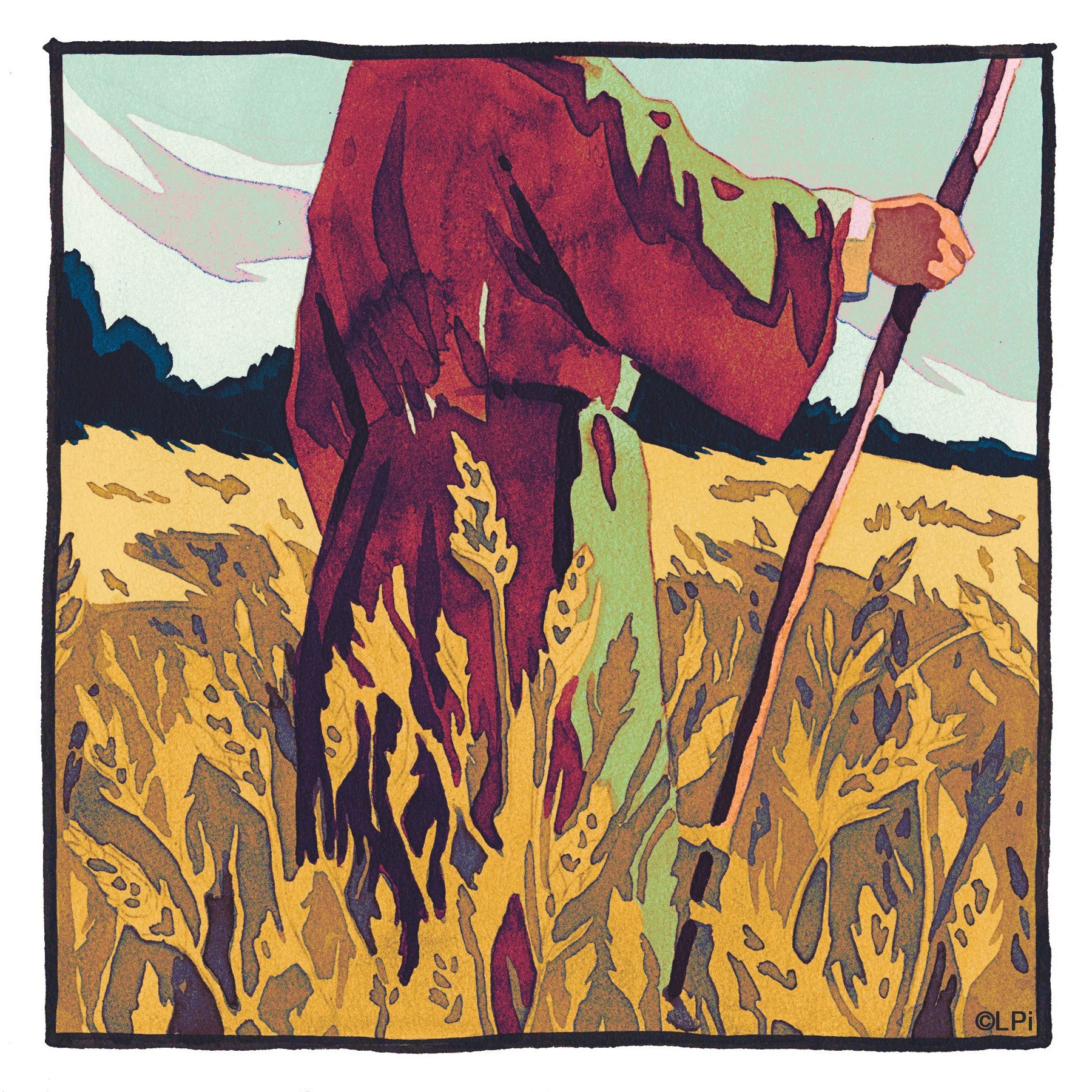
Again and again, Jesus demonstrates that his mission is anchored in compassion, as he is constantly reaching out to those who need forgiveness, healing, and wholeness.
And this Sunday’s Gospel highlights the mystery of Jesus’ compassion as the evangelist observes that, “at the sight of the crowds, Jesus’ heart was moved with pity… because they were troubled and abandoned, like sheep without a shepherd.”
His “heart was moved with pity” … that’s a beautiful image.
But if we look at this Gospel text a bit more deeply, we find that the evangelist uses a very specific Greek word to try to communicate to us what was happening inside of Jesus. The word is splanchnizomai. It literally means “he was moved in his guts.”
To say it another way, the sight of the crowds hit Jesus like a punch in the gut. Jesus wasn’t feeling sorry for them. He didn’t just hurt or ache for them. He was moved in the deepest part of himself because he felt their pain.
Jesus felt compassion.
He felt compassion.
But the Gospel does not present compassion as something Jesus keeps for himself. The compassion that moved him so deeply becomes the mission he entrusted to the Twelve. And, just as Jesus traveled throughout Israel teaching, healing, and proclaiming the Kingdom of God, the disciples were sent out to continue that same work in the world.
They were sent out to share with others what they themselves have received.
And so it is with us.
We have also been chosen. We have been called to live as disciples and the Good News of salvation has been entrusted to us, just as it was to the Twelve.
The question is not whether we have something to give. The question is whether we can remember what we ourselves have received.
Today, we’re being asked to be mindful and to name how, in our own lives, we have experienced God’s compassion: those times when we felt those eagle wings lifting us up—when the struggle, the illness, the grief, the sin, or the emptiness felt so big that we didn’t know how to take the next step… the next breath.
To remember those moments when hope returned. When healing came. When forgiveness was offered. When someone else's kindness, presence, or prayer carried us through a difficult season.
Perhaps we experienced that compassion through the care of that friend who sees and loves us as we are, through the patience of a partner or spouse, through someone who sat beside us in our grief, through the unexpected kindness of a stranger, or in the beauty of a sunset or garden in bloom in which God's goodness breaks into life's grey days.
This is the work of evangelization.
It’s not trying to convince others that our ideas about God are the right ones. It’s so much more that that—it’s giving witness to the compassion we ourselves have received.
And as we think of the pain, suffering, and anger that threaten to suffocate so many people in our world, we can also see that compassion is not optional for disciples of Jesus
Compassion moves us outward… out of ourselves. We are called to become that healing touch of Christ for others.
It moves us toward those who mourn, those who are suffering, those who feel forgotten or abandoned. Because this is what Christ himself does.
In the end, whatever form our ministry takes—and wherever our ministries and lives may lead us—the work of compassion is non-negotiable for disciples of Jesus: “Without cost we have received; without cost we are to give.” And, unless we open our hearts to the cries that moved Jesus in the deepest part of himself, we will never become the disciples that we are called to be.
May that Lord of Compassion grant us the grace to remember the times we were carried on eagle wings, because remembered mercy has a way of changing the human heart.
O God, strength of those who hope in you,
graciously hear our pleas,
and, since without you mortal frailty can do nothing,
grant us always the help of your grace,
that in following your commands
we may please you by our resolve and our deeds.
Through our Lord Jesus Christ, your Son,
who lives and reigns with you in the unity of the Holy Spirit,
God, for ever and ever. Amen.
-Collect for the Eleventh Sunday in Ordinary Time
Homily prepared for Three Holy Women Parish, Milwaukee, Wisconsin
