Epiphany of the Lord 2026
When Saint Luke wrote his account of the birth of Jesus, he spoke of shepherds tending their flocks by night. Inspired by an angelic messenger and the multitude of the heavenly host with their songs of God’s glory, these shepherds “went in haste and found Mary and Joseph, and the infant lying in the manger” (Luke 2:16). We hear this story in the Masses of Christmas Day.
Saint Matthew’s account of the birth of Jesus has a very different tone. Concerned as he is with demonstrating how Jesus was the fulfillment of the promises made to the People of Israel in past generations, Matthew draws on Old Testament images that would have been quite familiar to his Jewish-Christian audience. And so, he omits Luke’s pastoral account of the shepherds’ visit and tells a story of very different story of sages from the East who travel great distances—from far beyond the borders of Palestine—to worship this newborn “king of the Jews.”
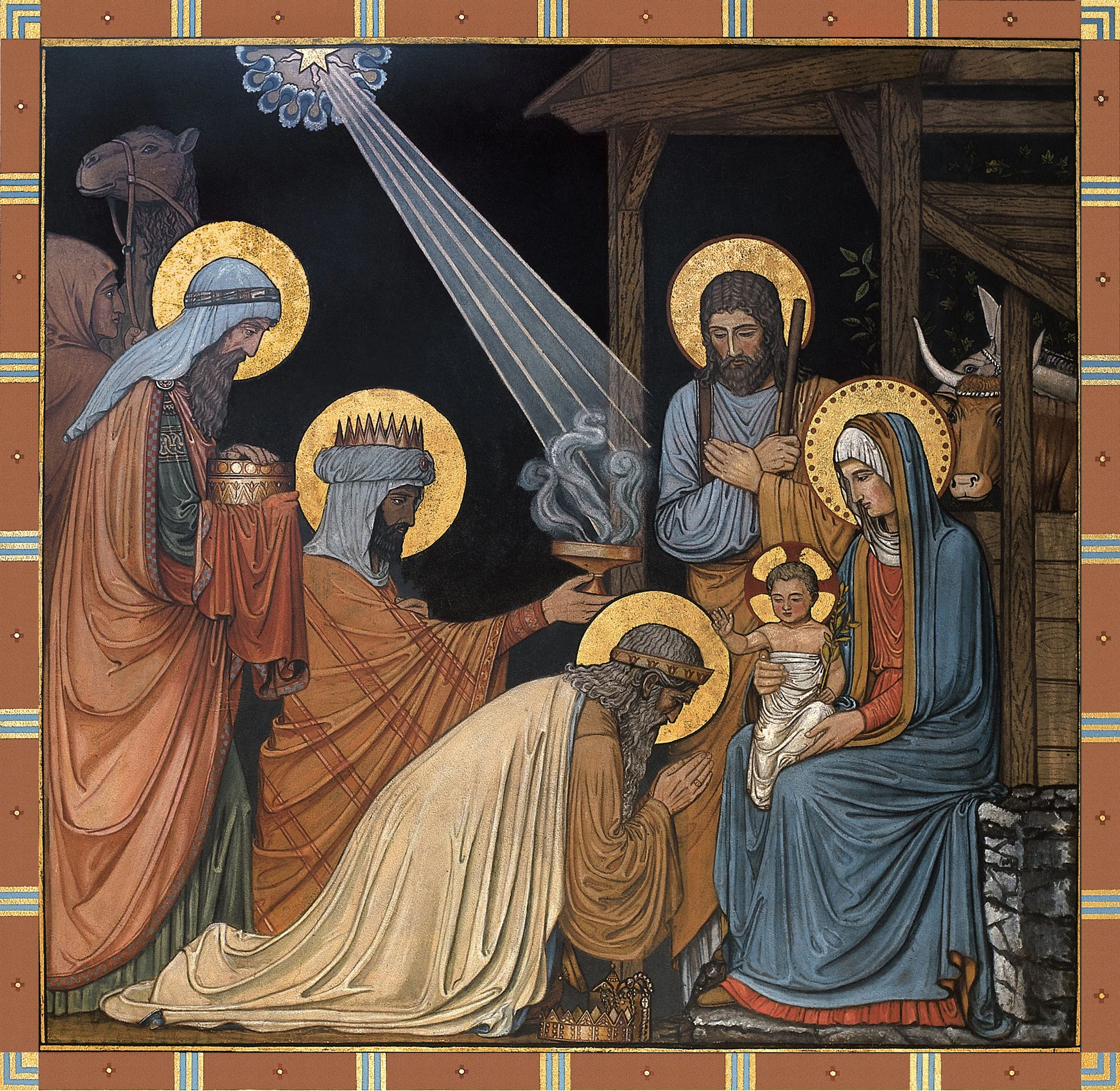
Unlike Saint Luke’s shepherds, who would have most likely been Jews, Matthew’s magi represented the nations—the Gentiles—and one of the primary messages of the Solemnity of the Epiphany is that this newborn King is not only the “king of the Jews,” as the magi called him, but that he is truly a king for all people.
This comes through in each of the Readings we hear on this Epiphany, as each one underscores the welcome extended to all in God’s embrace. Isaiah speaks of how peoples from every nation will stream toward the renewed Jerusalem, all bearing their gifts and proclaiming God’s praises. The responsorial psalm likewise sings of how every nation on earth will adore God’s Anointed One. The letter to the Ephesians emphasizes that “the Gentiles are coheirs, members of the same body, and copartners in the promise in Christ Jesus through the gospel” (3:6). The story of the magi illustrates that people of goodwill, regardless of their ethnic or religious background can also be responsible to the revelation of God. “Their openness brought the [magi] to the child, and they did not go away disappointed. This child draws Jew and Gentile alike” (from Preaching the New Lectionary: Year A).
Beyond this important truth—that Jesus is the Savior of all nations and peoples—we also learn about this child as we reflect on the gifts of the magi.
First, there are the gold and frankincense, which were referenced by the Prophet Isaiah in the First Reading. These have traditionally been understood as references to the Christ’s royal status (the gold) and his divinity (the frankincense—which would be offered to a deity in religious rituals).
But it was only those two gifts… Matthew also tells us about the gift of the myrrh.
In the ancient world, myrrh was used as an elixir or medicine, as a drug, and, more specifically, as a perfume in the burial rites in various cultures, because it’s scent was strong enough to cover the smell of decaying flesh. In the Old Testament, myrrh is most notably used by Moses as an ingredient in the oil utilized in sacred anointings, as well as by Queen Esther in a ritual of purification. Scholars tend to agree, however, that the gift of myrrh, as it is being offered by the magi in Matthew’s gospel, not only hearkens back to Moses’ religious rituals and Queen Esther’s purity, but it also serves to help us understand that this Child, who is both a King and Divine, is also fully human and that human death will be an indispensable part of his story. We even sing about this in John Henry Hopkins’ classic carol “We Three Kings”:
Myrrh his mine; its bitter perfume
Breathes a life of gathering gloom;—
Sorrowing, sighing,
Blessing, dying,
Sealed in the stone-cold tomb.
The myrrh at the manger is a reminder to us that the mystery of the Incarnation is inseparably tied to the fullness of the Paschal Mystery.
But rather than cast a shadow over this happy feast, this should in fact serve as a source of hope and consolation as we continue to confront dark realities in our lives and in the world, even during this season of light: we know that the cold of the tomb, symbolized by the myrrh, was not the end of the story.
Even these Christmas days are illuminated by the light of Easter glory.
All of this is why Pope Benedict XVI could offer these words in his 2010 homily for the Solemnity of the Epiphany:
“Thus if we read together the promise of the Prophet Isaiah and its fulfilment in the Gospel of Matthew in the great context of all history, it is evident that what we have been told which we seek to reproduce in our Nativity scenes is neither a dream nor a vain play on sensations and emotions… but is the Truth that irradiates in the world, although Herod always seems stronger, and that Infant seems to be found among people of no importance or who are even downtrodden. But in that Baby is expressed the power of God, who brings together all people through the ages, because under his lordship, they may follow the course of love which transfigures the world.”
The invitation for us on this Epiphany is to reflect on the full meaning of the Christmas Mystery and on who it is who has been born for us and to offer a prayer of thanks for the gift of this Savior.
Homily prepared for Ss. Peter and Paul Church in Milwaukee, Wisconsin
