In the Gospel for this Feast, Jesus offers a sort of litany of blessings to people who have been cast off by society: the meek, those who are mourning, those who hunger and thirst for righteousness, peacemakers… Jesus doesn’t say, “Blessed are the rich, the powerful, and the successful.”
Instead, Jesus offers God’s blessings to those whose lives reflect the priorities of his Kingdom. We can think of someone like Saint Josephine Bakhita, a woman from Sudan who, after years of enslavement, found the grace to forgive those who claimed to be her “owners.” Her life reminds us of the meek, those who place their trust in God and discover that their dignity cannot be taken away by the actions of others.
Jesus blesses those who mourn, as he did Saint Monica, a woman who lived in fourth-century Roman North Africa, in what is today Algeria. After years of tears and prayers, she saw her unbelieving son Augustine become a Christian and a leader in the Church. Her story reminds us that even in the midst of heartache, we can remain faithful and trust in God's grace.
Jesus blesses those who hunger and thirst for righteousness. We have someone like Saint Martin de Porres from Peru, who faced racial discrimination because of his ancestry, yet eventually made religious vows and devoted himself to caring for the sick and those in need, without regard for their status or the color of their skin. His life became a witness to the dignity of every person and to the kind of justice Jesus calls us to seek.
Jesus blesses the peacemakers and those who are persecuted for the sake of righteousness. We see this in Saint Oscar Romero, a bishop who served the people of El Salvador in dangerous conditions before he was assassinated while celebrating Mass. We also remember Saint Lorenzo Ruiz, a Filipino layman, husband, and father who was martyred in Japan after refusing to renounce his Christian faith. Both remind us that faithfulness to Christ sometimes requires extraordinary courage, even when the cost is great.
The saints whom we honor today—and this includes those holy women, men, and children whose names we know, and those whose names are known only to God—believed that Jesus meant what he said in the Beatitudes. They trusted in God's love and mercy even when things seemed to be at their darkest.
The Beatitudes do not tell us that suffering is good in itself, or that God wants us to endure injustice without doing anything about it. They remind us that suffering, injustice, and grief do not have the final word. God does not abandon those who suffer, and the saints show us what it means to live in the hope Jesus promises.
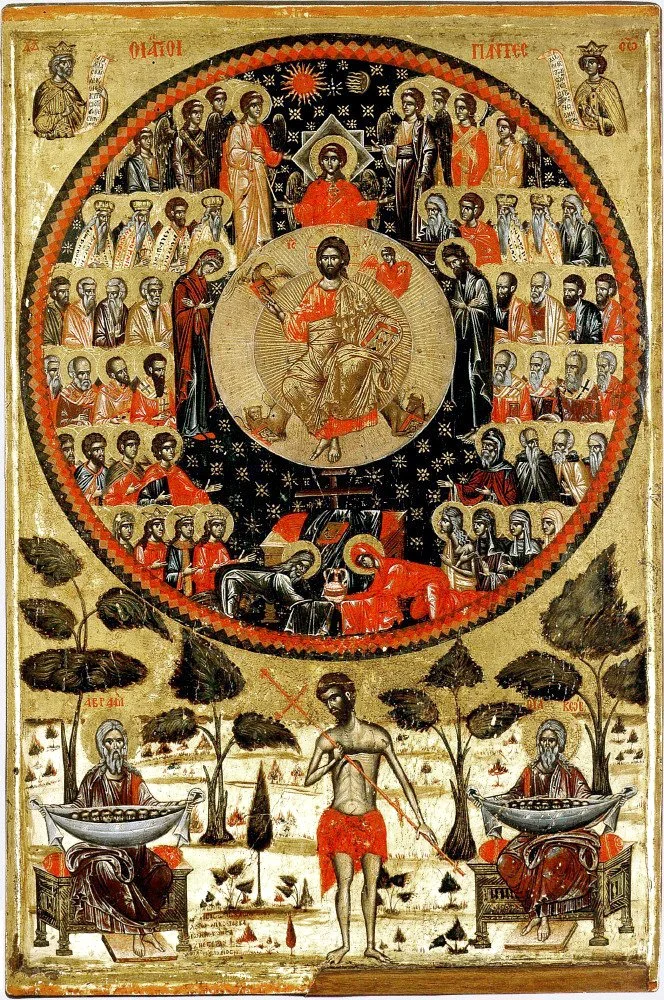
And the saints remind us that recognizing God's blessings in our own lives should lead us to gratitude. The gifts we have received—our abilities, our opportunities, our relationships, and the love and mercy we have experienced—are not simply things to hold on to for ourselves. The Beatitudes are not simply promises we receive; they describe a way of life we are called to share with others. Those who have known mercy become merciful. Those who have experienced God's love become instruments of that love. Those who hunger for righteousness work to make the world more just.
If we look across the vast horizon of personalities who make up the communion of saints that we celebrate today, what do we see?
We discover diverse women who spoke their minds to popes and kings, who built monasteries, churches, and hospitals, who raised families, and even led armies. We find men who rejected armies and power to give themselves over to peace and to cultivating what is good in the Church and the world. We discover women, men, and children who were able to defy what the world told them they were supposed to be because they committed themselves to Christ and to the work of making the Reign of God real in their own time and place.
Think of our own patron, Saint Pius X. He came from humble beginnings and became pope, yet his life and ministry were marked by a desire to help people grow in their faith and participate more fully in the life of the Church.
Or think of Saint Carlo Acutis, who died in 2006 at the age of 15, and used his gifts and knowledge of technology to share his love for the Eucharist. His life reminds us that holiness is not reserved for another generation, another place, or another kind of person. It can take root in the circumstances of our own lives.
This is where we can begin to unlock the “secret” of the saints: they believed in the blessings promised by Jesus, and they became disciples who did something with their faith. They lived what they believed in ways that changed the world around them.
And these changes weren’t always the grand sorts of signs and wonders that we like our saints to perform. Usually, their faith was lived out in the most ordinary aspects of life, moment to moment, day to day.
Think about it. Even if we take the stories we know of beloved saints like Saint Francis of Assisi, Saint Teresa of Kolkata, or Blessed Francis Jordan, the founder of the Salvatorians, those stories give us only the faintest hint of what their daily lives were like. And just as our lives can never really be summed up in a single moment or experience, their lives were a succession of moments in which they chose, again and again, to try to want more, to try to be more, and to keep their attention focused on a way of living and loving that was bigger than they could ever hope to become.
The same is true for us. We may never know the full effect of a kind word, a decision to forgive, a refusal to participate in injustice, or the willingness to remain present to someone who is suffering. These choices may seem small, but they are ways of putting our faith into practice. They are ways of living the Beatitudes.
All Saints Day reminds us that we need to hear and celebrate the stories of the saints because they show us what a life of discipleship can look like. Their stories are not simply accounts of remarkable people from the past. They invite us to consider how we are living our own lives, how we respond to the needs of others, and how we make God's love visible in the world around us.
This great cloud of witnesses reminds us that holiness takes many forms, but it always draws us more deeply into the life of Christ. The Beatitudes remind us that this life is not measured by worldly success, power, or recognition, but by the way we love, the way we show mercy, and the way we work for peace and justice.
Today, we celebrate the saints who have gone before us and the grace of God at work in their lives. Their examples remind us that the Christian life is about more than what we accomplish or what we do. It is about who we become as we allow Christ to shape our lives. Like the saints, we are called to keep striving to do more, to be more, and to become people whose lives reflect the blessings Jesus promises in the Beatitudes.
Almighty ever-living God,
by whose gift we venerate in one celebration
the merits of all the Saints,
bestow on us, we pray,
through the prayers of so many intercessors,
an abundance of the reconciliation with you
for which we earnestly long.
Through our Lord Jesus Christ, your Son,
who lives and reigns with you in the unity of the Holy Spirit,
God, for ever and ever. Amen.
-Collect for the Solemnity of All the Saints
