The Twenty-Sixth Sunday in Ordinary Time (2026)
For the evangelist Matthew, discipleship consisted of a series of choices made, again and again, to follow Jesus. We see this throughout his Gospel—in the many interactions between Jesus and the Pharisees and scribes, in Jesus’ instructions to his disciples, and in the stories of people who were invited to change the direction of their lives. Discipleship is not simply about one decision we made in the past. It is about allowing our faith to shape the choices we make each day.
And at the heart of those choices is the strange and sometimes difficult mercy of God.
Graham Greene was a Catholic and British novelist who has come to be regarded as one of the greatest English-language writers of the last century. In his novels, plays, and short stories, Greene explored the power of faith to transform daily life, especially through mercy and sacrifice. Anyone who has read The Power and the Glory, The End of the Affair, or Monsignor Quixote knows how artfully Greene explored the complexities—and darkness—of life and faith.
In one of his non-religious novels, the thriller Brighton Rock, Greene nevertheless finds an opportunity to reflect on God's mercy and the hope of redemption when he writes, “You can’t conceive, my child, nor can I or anyone, the appalling strangeness of the mercy of God.”
Greene is right. When measured against human standards, God's mercy can seem appallingly strange. God does not wait for us to become perfect before loving us. God continues to call us even when we have resisted, failed, or turned away.
We see something of that strange mercy in this Sunday’s Gospel…
Jesus tells the story of a father who asks his two sons to go and work in the vineyard. One says no, but later changes his mind and goes. The other immediately says yes, but never goes.
Neither son gets everything right.
And that is one of the reasons I find this parable so human. Both of the sons exist within each of us.
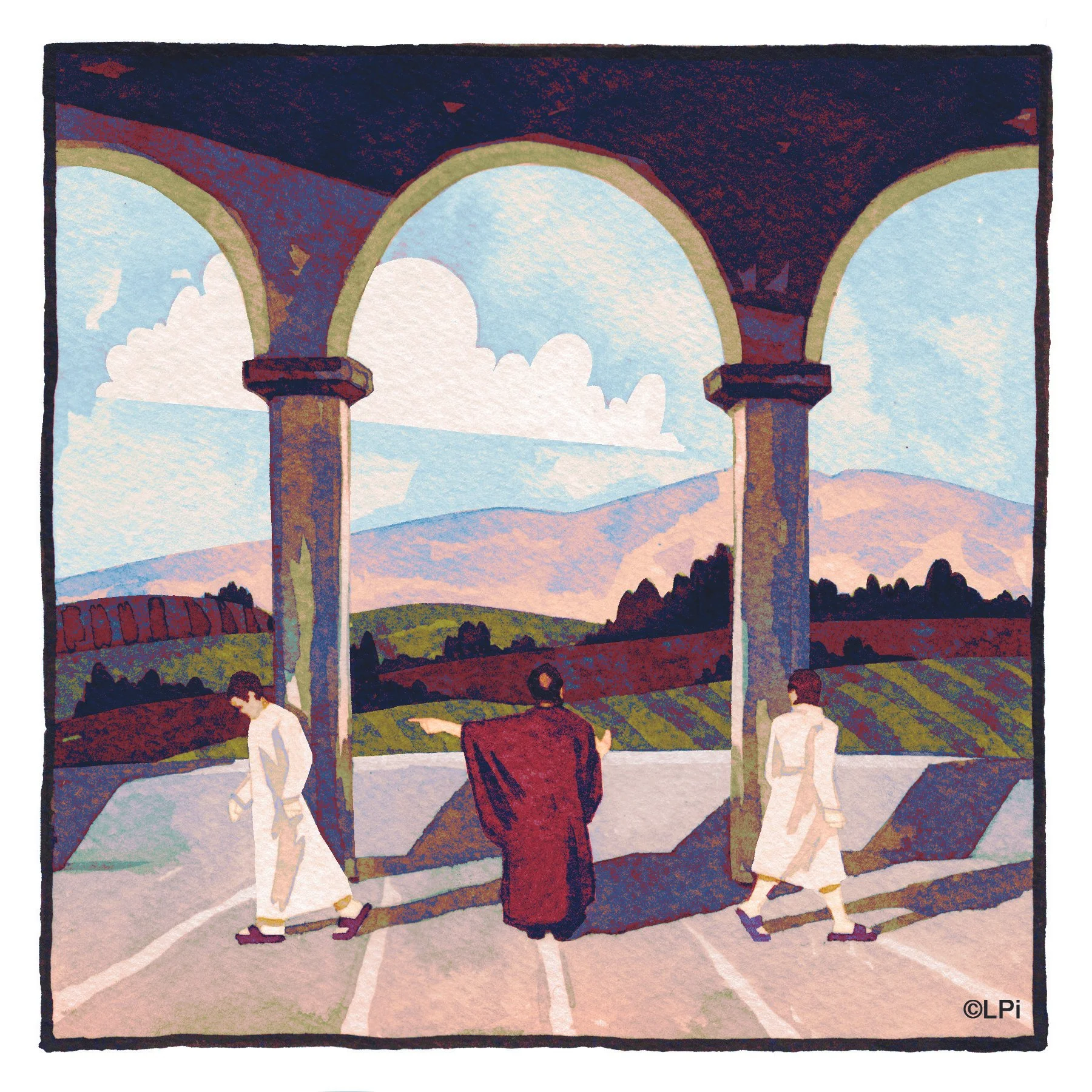
There are times when we have been asked to do something we didn't want to do. We said no. We resisted. We argued with ourselves or with someone else. And then, for whatever reason, something changed within us. We thought about it again. We listened. We recognized that what was being asked of us was right, and we went.
And there are other times when we have been the second son. We said the right thing. We made the promise. We intended to do what was asked of us. But somehow the intention never became action.
That distinction matters to Jesus.
The father isn't ultimately interested in which son gave the right answer in the moment. He wants to know which son actually did his will.
Jesus models this way of surrender for us in his own obedience.
Although “obedience” is an unpopular word in our contemporary culture, it is one of the non-negotiables of Christian life. Christian obedience is not about power or submission. It is about relationship. To be obedient to another person is, at its deepest level, to listen to them and to respond to what they ask of us.
Our word “obedience” comes from the Latin oboedire, which can be translated simply as “to listen.” Saint Benedict speaks about listening with “the ear of the heart.” To be obedient to God means listening with that kind of attention and allowing what we hear to shape the way we live.
In his letter to the Philippians, Saint Paul reminds us of the obedience of Jesus, who “humbled himself, becoming obedient to the point of death, even death on a cross.” Jesus offered his life as an act of obedience to God the Father for our sakes. He recognized what the Father was asking of him and surrendered his life on the Cross as the greatest act of love that is possible.
This is what makes Christian obedience different from simple compliance.
Jesus didn't obey because he was powerless. He obeyed because he loved. And that is what we are being invited to learn.
For most of us, this doesn't happen in dramatic moments. It happens in the ordinary circumstances of our lives.
It happens when we listen to someone we love even though we would rather defend ourselves.
It happens when we recognize that we have been wrong and take the first step toward reconciliation.
It happens when we choose to care for someone who has become dependent upon us.
It happens when we put aside our own preferences because we recognize that another person's needs matter.
It happens when we sense that God is asking something of us and, even though we are uncertain or reluctant, we take the next step.
Obedience is a process of surrender that unfolds gradually over the course of a life of prayer, service, struggle, and, yes, even setbacks. Obedience is a process of surrender that unfolds gradually over the course of a life of prayer, service, struggle, and, yes, even setbacks.
The French Jesuit Jean Pierre de Caussade reflected on this surrender, writing, “The free gifts he asks of us are self-denial, obedience and love. The rest is his business.” I think that is a beautiful description of the Christian life.
We don't always know where God is leading us. We don't always understand why something is being asked of us. And sometimes, like the first son, our first response is no.
But God continues to speak.
God continues to invite us.
There may be something God has been asking of us for a long time—a conversation we need to have, a forgiveness we need to offer, a change we need to make, a responsibility we need to accept, or a generosity we have been resisting. We may not have said yes the first time. We may even have said yes without following through. But God's invitation remains.
Faith cannot remain simply something we believe. It has to become something we do. Our faith has to take shape in the choices we make and in the way we live.
And so the invitation of today's Gospel is simple: listen with the ear of the heart. Allow God's invitation to reach beyond our intentions and into our lives. And when we hear the voice of Christ calling us, let our yes become a way of life.
O God, who manifest your almighty power
above all by pardoning and showing mercy,
bestow, we pray, your grace abundantly upon us
and make those hastening to attain your promises
heirs to the treasures of heaven.
Through our Lord Jesus Christ, your Son,
who lives and reigns with you in the unity of the Holy Spirit,
God, for ever and ever. Amen.
-Collect for the Twenty-Sixth Sunday in Ordinary Time
Homily prepared for Pope St. Pius X Parish in Wauwatosa, Wisconsin, and Ss. Peter and Paul in Milwaukee, Wisconsin
